
Maria Connolly, LPC Facebook Facebook Facebook

Tag: Self-Confidence

Self confidence requires making subtle shifts in how you use your body as you create mindfulness and awareness that exponentially increases your ability to influence, listen, be resilient, manage stress, maintain energy and be more effective. Rather than numbing yourself to uncomfortable circumstances and powering through them, you can learn to mindfully choose to respond in a way that leaves you feeling whole and at peace.

Finding Your True Self – The Key to Embodied Leadership

Embodied leadership requires you finding your true self, not what you’re comfortable with right now, but unlocking your authentic self with integrity.“Behind your thoughts and feelings, my brother, there stands a mighty commander, an unknown wise man— he is called Self.  He lives in your body, he is your body.  There is more reason in your body than in your best wisdom.” ~ Friedrich Nietzsche

Has there been an opportunity in your life where you know you should step up and take the lead? But you find yourself thinking, “That’s not me. I could never be a good leader.” If you’ve thought this, it may be time you invested some effort into finding your true self.

Now usually when people think of being true to themselves, they’re thinking of what comes easily to them, what is comfortable to them, what’s familiar, what they’re used to doing and being. That’s not what I’m referring to when I say finding your true self.

The truth is who you are today isn’t who you were last year, nor does it have to be who you will become tomorrow. Much of who you are – your strengths, weaknesses, desires, and ambitions – may be attributed to genetics and the surroundings you grew up in. Yet you don’t have to be bound by the whole nature-versus-nurture debate. Because beyond those factors, is the empowering truth that you have the greatest gift of choice. You can choose to become whoever you want to be.

So it would be a mistake to limit yourself by self-imposed boundaries. Being your authentic self means embracing what and who you are now AND actively unlocking the full potential of what and who you can dynamically become through mindful, personal growth. And not just doing this as a brain exercise but with a somatic approach, as you create a greater awareness of how your thoughts guide your body to act and respond. This awareness allows you to be present in the reality of now, but also unlocks the potential for choosing a better, more fully developed way to be.

Finding your true self is on ongoing process. We shape ourselves through the self-narrative process – the stories we tell ourselves and others.

To illustrate this simply…

If you tell yourself you’re fearful, you’ll tense your muscles, your vocal cords will tighten, and your teeth will clench. And no matter how hard you try to hide it, it still shows. However, if you tell yourself you’re safe, you relax. People around you can sense what’s going on within your inner self, your authentic self.

We’ve all seen leaders who have people eating out of their hands. How do they do that? Well, charismatic leaders have mastered a way to manipulate the emotions without delivering genuine substance. That’s a here today, gone tomorrow approach.

Embodied leaders, on the other hand, have the heart to connect with people on their level, building rapport and trust as they deliver value and substance. Their whole demeanor – their facial expressions, their words, the tone of voice, their body language – exudes confidence, helpfulness, and trustworthiness. Yet did you realize they are also feeling the fear and anxiety that you do? That’s part of the human experience.

Embodied leaders have learned that being your authentic self means being aware of these conflicting emotions and owning them, balancing them, resolving them, as you choose the ones that serve you in any particular situation. That choice leads you to acknowledging those feelings to the group and then consciously using your body to reveal feelings that your audience needs to see. Yes, you are fearful. But you chose courage and determination to be your dominant attitude. So through employing somatic techniques your body relaxes, opens up and connects with them.

embodied_experience

Creating an authentically, embodied leadership through finding your true self involves primarily three things:

  1. Being vulnerable enough to expose your real self without fear of rejection, knowing that expressing vulnerability fully engages with and establishes trust.
  2. Being present without blame and relating to others as you inquire of their feelings, values, and strengths, thereby seeing the best in them, that their motives and desires are good.
  3. Being strong enough to stand up for your values, while making executive choices, putting personal preferences aside, so as to benefit the group as a whole.

If you’re still saying, “That’s not me”, but deep down you’re saying, “I wish it was me”, then never stop searching for how you can expand, refine and dig deeper into your potential. Try out new ways of being as you continue finding your true self. You don’t have to make this journey alone. I would love to work with you. Contact me and we can work in-person if you can commute to Ashland, Oregon. Or we can work together via Skype. Nothing is unattainable for you, when you try.

Embodied Leadership – How to Bring Out the Best in You and Everyone Around You

Embodied leadership means you bring out the best in yourself and others, as you’re always fully aware of what your mind and body are saying to you and them.“We don’t need leaders who know about leadership. We need leaders who embody the capacity to lead in the midst of ambiguity and complexity.” ~ Pete Hamill

Does it feel like something is missing from the way dictionaries define leadership – “someone who guides, directs, controls, manages, or supervises a group of people or an organization”? People may comply when they are controlled or managed but it doesn’t create a team environment that fosters a synergy where, as a group, you accomplish greater things than you ever could as individuals.

If that synergy – which brings out the best in yourself and others – is what you’re interested in, then I’d like to introduce you to embodied leadership. It involves the way you speak, the language you use, the way you position your body, the harmony you feel by being fully present, and the calming and reassuring messages you convey to others. Ultimately, it’s about the quality of your presence and your way of being. When you practice embodied leadership you’re able to value, motivate, and bring out the best in yourself and the people around you.

Embodied leadership isn’t something you do – it’s who you are. By learning to connect the mind with the body and soul, and to lead with purpose, you can “lead at a deeper levels of self-awareness, developing your abilities to be the leader you want to be, and achieving what you are committed to achieving,” as stated by Pete Hamill. (He’s the author of Embodied Leadership – The Somatic Approach to Leadership, a book I highly recommend).

Somebody who embodies leadership in all aspects of life has a clear vision for how she wants her life to be – her personal life, her family, her home, and how she want to contribute to helping other people. It will make her a better wife, mother, friend, boss, advocate, or neighbor.

As women, we may tend toward feeling powerless at times and unable to compete in the world of male-dominated leadership. But you don’t need to compete. When you connect authentically with yourself, you can release the most important power any leader can have – not the power to dominate and control – but the power to build authentic relationships and empower others to make things happen. True leadership isn’t about barking out orders, but it’s the ability to sort out the chaos and come up with solutions that keeps the group moving forward.

How do you develop your embodied leadership potential?

Start by being more mindful of your body. For example, a 2010 study showed that open, expansive postures results in actual hormonal and neurochemical changes (testosterone elevates and cortisol, the stress hormone, lessens). And the subjects of the study gained a greater feeling of power and tolerance for risk, whether they were male or female. While contracted, closed postures had the opposite effect. 

Becoming more comfortable in your own skin is the first step to embodied leadership. The somatic approach to leadership assists you in centering yourself. It gives you the awareness to see where you hold tension, and teaches you how to release it gently. It gives you the confidence and poise to stand up for what you believe to be true and important, so you can assert yourself without fear. If you’re ready to step into your own power more fully, I’d be happy to guide you. Contact me to learn more. We can work in person if you live near Ashland, Oregon, or via Skype if you live elsewhere.

This is the beginning of a series on Embodied Leadership. You’ll find the next installments below.

Read related information on Embodied Leadership:

Develop Leadership Skills in Women Who Want to Make a Difference

Women in Leadership Who Excel Have High Emotional Intelligence

20 Amazing Benefits of Applying Embodied Leadership Principles to Your Relationships

Finding Your True Self – The Key to Embodied Leadership

Principles of Aikido Empower Embodied Leaders to be Calm under Crisis

How Embodied Leadership Succeeds Where Other Leadership Styles Fail

15 Highly Organized Characteristics of a Leader to Create a Lifestyle You Love
15 Highly Organized Characteristics of a Leader to Create a Lifestyle You Love

Find 15 characteristics highly organized leaders cultivate in support of a busy lifestyle and learn 7 reasons why you’ll want to use them in your life too “Good order is the foundation of all things.” ~ Edmund Burke

People who focus on excellence, like leaders and business coaches, know that their best performance starts with becoming highly organized and that “Clutter is a state of mind.” A cluttered space begets a muddled mind and vice-versa.

I have a confession: I’m unusually organized. Not only do I make my bed every morning, I also find a way to tidy up and declutter as I go. I partly inherited this from my mother. I suspect her neatness was a way to cope with stress and anxiety. I’m so glad this gave me a model for creating a simpler, clutter-free environment.

Being highly organized is not only a way to create pleasant spaces but also a strategy for doing anything in life. It means being clear about what you want, being able to prioritize, setting outcomes and the respective steps to make your way to the goal.

We can’t run around stressed all the time with a million things on our mind and expect to perform at our best. So…how are you going to change your lifestyle to one that’s more organized?

Take a look at the following highly organized characteristics that leaders cultivate. (You can do the same with daily, mindful attention.)

1. Be undistracted by uncluttering your mind. Learn to work through the daily stress in a way that let’s you forget it and move on. For some, the best method is a vigorous workout. Others like yoga, walking, or talking with a friend or professional. Personally, I love Crossfit, Archery, and Aikido.

2. Be proactive. If a task takes fewer than five minutes, do it! Pick it up, wipe it down, put it away. That way work doesn’t frustratingly pile up.

3. Be goal oriented. Create an environment that makes it easy to achieve your goals. It’s easier to let things go when they’re not attached to your goals.

4. Be optimistic. The can-do attitude keeps you on track. Focus on filling your mind with the positive things you can do, even if they seem small.

5. Be decisive. Wishy-washy gets you nowhere. Consider your options, pick the best one and work it to the best of your ability without looking back.

6. Be imperfect. Don’t become immobilized in the minutia of the details. It’s never going to be perfect, so determine when it’s good enough and move on.

7. Be list, calendar, and container oriented. Make a place for everything, and put everything in its place. This applies to physical items and routinely scheduled events. You’ll know where it is when you need it and you’ll know if you have a slot open in your schedule for invitations and requests. Capturing your ideas in a detailed list of tasks frees up your mental energy. Referring to your list and calendar often keeps you on-task. This helps you foresee any potential conflicts that might interfere with your goals.

8. Be able to say, “No.” When you know exactly what you want, it’s easier to turn down invitations and requests that don’t fit into your goals.

9. Be prepared. Know how much time you have to complete a project and leave enough time, including a cushion for unexpected occurrences, to do it.

10. Be focused. Avoid multi-tasking. It’s better to protect your time by shutting out distractions and focusing on doing one task at a time.

11. Be aware of your strengths and play to them. Define how you want to live your life such as how you want your home to look, how you want to dress, how you spend your time. This makes it easier to set goals and accomplish them. Do your most taxing work when you’re alert and energized.

12. Be willing to ask for help. Trying do it all yourself only causes more stress. Respect your most valued resource – time – and use it wisely.

13. Be content. Just because you see something beautiful you don’t need to possess it. Just because it’s on sale, it’s not a good deal if you don’t really need it.

14. Be in love with what you own and do. Everything need to be cared for and maintained whether these are relationships, skills, or possessions. Streamline your focus to the place where you can thrive.

15. Be choosy. Don’t attach sentimental value to everything you own. For example, just because you inherit your parents’ furniture, it’s okay to pass it on to someone else if it doesn’t fit your lifestyle.

What I love about being highly organized is that it:

      1. Saves time in the long run,
      2. Lessens your stress because you’re not “playing catch-up”,
      3. Makes you feel better about yourself,
      4. Prepares you for everything,
      5. Empowers you to say NO to excess and say YES to what you really want,
      6. Energizes you as you stop procrastinating, and
      7. Shifts your focus from quantity to quality.

Being organized is about striving for optimal effectiveness and maximum efficiency in any task. It is about feeling more in control, about the thrill of setting things up for success. Wouldn’t you love the freedom to be exactly who you’re meant to be as you enjoy each moment of life? Becoming organized can get you there! Contact me and let’s work together on ways that empower you to make lasting change. I’m looking forward to hearing from you!
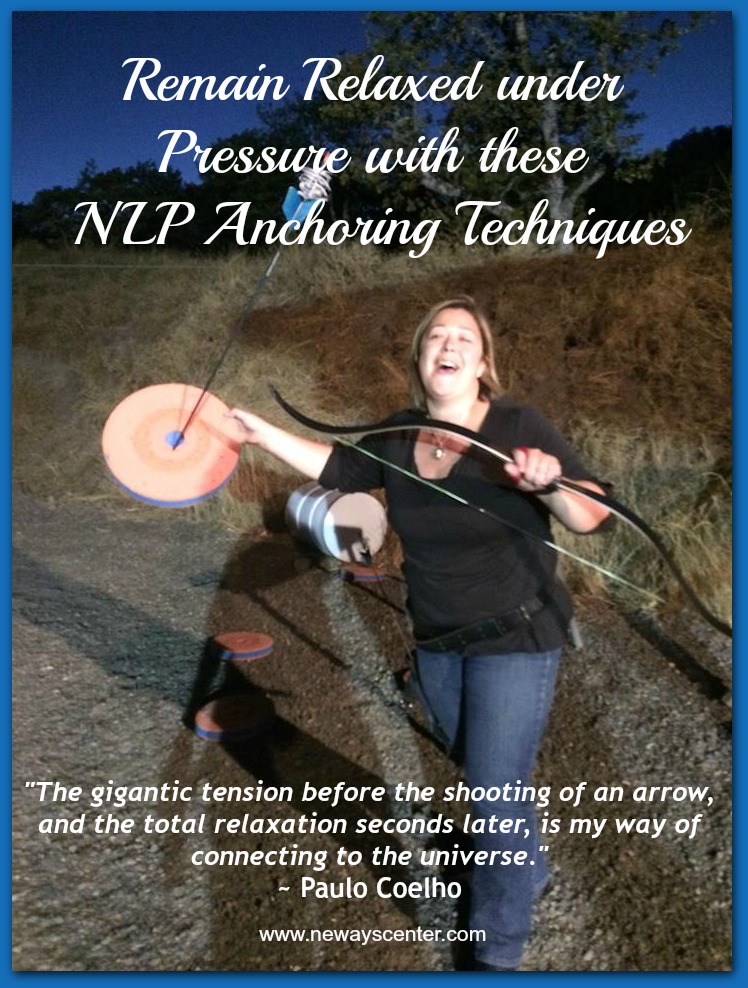
Remain Relaxed Even Under Pressure with these NLP Anchoring Techniques

Remain Relaxed Even Under Pressure with these NLP Anchoring TechniquesStressed out. Strung out. Uptight. On edge. Tense. Nervous. People have such a hard time achieving a deeply relaxed state of mind. Any little thing can set them off, send them over the edge. This is taking a terrible toll on the emotional, mental, physical, and spiritual health of us and our loved ones.

Earlier, I shared a number of ways to achieve deep relaxation through Progressive Muscle Relaxation and simply making time for things you enjoy. (Yes, that’s me in the picture. I love archery!) As mentioned, to get the most benefit, focus on relaxation via the body, via the mind, and via the soul.

What do I mean by Deep Relaxation via the Soul?

A lot of people say that they can’t relax because their lives are chaotic and messy. It’s important to practice your ability to relax fully no matter the circumstances or the conditions around you. Neuro-Linguistic Programming (NLP) teaches us that we can choose any psychological state at will. This means that you can experience bliss, joy, gratitude, or love no matter what is happening in your life. And one of the NLP techniques that helps you do this is called “anchoring”.

In NLP, “anchoring” refers to the process of associating an internal response with some external or internal trigger so that the response may be quickly and subtly accessed.

NLP anchoring techniques are based on science. Russian scientist, Ivan Pavlov, famously demonstrated how conditioning works. He rang a bell every time dogs were fed. Soon the dogs psychologically associated the smell and taste of food with the sound of the bell. So even if the food was not present, the dogs would salivate at the sound. The bell (an external trigger) caused a real physiological response (salivation) even though the smell and taste were absent.

NLP anchoring techniques similarly cause you to psychologically associate a signal or trigger (tapping your chest, snapping a rubber band, squeezing your fingers) with a physiological response (an emotion, mood, or mental state) of your choice. When you experience a negative emotion, you can trigger a positive emotion and extinguish the negative one. This thereby allows you to choose your mood or state of mind no matter what the circumstances are.

Here are 7 Easy Steps to Anchoring a Resourceful State of Mind:

  • Decide on the state you want to anchor. For example being calm and relaxed.
  • Recall a memory or imagine a situation where you can experience the state. Make it very detailed and vivid, using all your senses.
  • When the experience is vivid and you’re in the desired state, connect it with a part of your body. For example, put your hand on your heart when the state is at its peak!
  • Now, break state by removing your hand and doing something else. Open your eyes, count down from 10 to break state and distract yourself.
  • Apply the anchor by just placing your hand on your heart and check that the required state, such as calmness or peace, occurs again.
  • You may need to repeat the anchoring process a number of times to make the experience sufficiently intense.
  • Use your new anchor in the situation where you want to experience the desired state. For example, when you’re feeling stressed during your next business meeting, place your hand on your heart and make sure it creates a sufficiently robust resourced state of calmness.

NLP anchoring techniques are really a method of deep relaxation that is best learned under the guidance of a trained professional. If you’d like to add this excellent tool to your life skills, please contact me and I’d be happy to help you finally achieve the peace you crave.

Improve Your Personal and Business Communication through Touch

Improve personal and business communication through touchAren’t you drawn to warm, affectionate people? We feel immediately comfortable with them. What is it that makes them so approachable? It might be the warmth of their smile or their eye contact with you.

However, if you pay attention, you might be surprised to find how often warm people touch others. They shake hands with firm, full palm contact…not a limp-fish handshake. They may even pat you on the shoulder as they shake your hand. Or they let their hand rest just for a moment on your forearm. Or they greet you with a side hug, knowing that a full hug seems too intimate and may make you uncomfortable. All during the conversation, they continue to communicate through touch.

Touch is our primary language of compassion. Maybe you can remember a time when you were hurting, and a trusted confidante or parent enveloped you in their arms. Your heartbeat slowed, your sobs subsided, and you were able to breathe again. Touch changed your life at that moment. You knew you were not alone. Someone was there for you.

Communication through touch is fundamental to human bonding and health. At Berkeley University of California they studied whether people can communicate compassion through touch. They built a barrier in the lab that separated two strangers. One person stuck his or her arm through the barrier and waited. The other person was given a list of emotions. He or she had to try to convey each emotion through a one-second touch to the stranger’s forearm. The person whose arm was being touched had to guess the emotion.

Remarkably, the guesses were correct nearly 60 percent of the time. They got the emotions – gratitude, anger, love, and fear – right more than 50 percent of the time. Gender seems to have a bearing on the results. Interestingly, when a woman tried to communicate anger to a man, he had no idea what she was doing. And when a man tried to communicate compassion to a woman, she didn’t understand it.

In another study these researchers found, “People can not only identify love, gratitude, and compassion from touches but can differentiate between those kinds of touch, something people haven’t done as well in studies of facial and vocal communication.”

People understand your words better if you touch them. No that doesn’t mean if you’re angry you should punch someone. However, when you’re working to keep the line of communication open enough so that you can touch them, you’ll be more mindful about controlling your emotions. As you touch them, it reminds you that you love and appreciate this person and you want to mend the rift in your relationship, which helps you calm down. And they will feel that intention despite the hurt or anger and will be more open to listening to you.

Do you see how powerful touch can become in your communication? Which do you think will have more success? Yelling at your daughter to “get in here” then standing with your hands on your hips glaring at her? Or putting your hand on her shoulder, guiding her to the couch where you can sit closely as you look her in the eye and discuss the problem earnestly?

In the office, which will create greater team spirit and employee loyalty? Sitting behind your desk, writing on a notepad as you talk with an employee? Or greeting the employee at the door with a handshake and pat on the shoulder as you guide them to chairs that are next to each other?

Remember, to pay close attention to the signals that someone might be uncomfortable with being touched. You want to respect their boundaries so you don’t unwittingly increase their stress. Also, because of your background and upbringing, you may not feel comfortable with touching or being touched. But you can choose to make changes in an effort to improve your communication skills. It’s a basic human need. Not only will it make you healthier, it will make your relationships thrive.

Somatic coaching and therapy is an excellent way to create subtle shifts in how you use your body to influence, listen, and communicate. If you’re ready to make real and lasting changes in how you relate to others, contact me to learn how in a way that leaves you feeling wonderful and at peace.

Touch is just one of the indicators of a healthy life. Take the 7-Point Body Wellness Assessment to see how you measure up. Click here to download your free copy. And don’t forget that January 21, 2016 is National Hugging Day. Who will you hug?


Let's get started with 30 free minutes

I invite you to learn more about me and my coaching and counseling services. Please contact me to schedule an “It starts with you!” 30-minute complimentary consultation with me, in-person, by phone or via video consultation, so we can explore our partnership.

SCHEDULE


How to Step Forward to a Future You've Created

Discover how to replace your old, self-limiting map with a new map full of possibilities for the future

DOWNLOAD YOUR FREE INTRO TO STEPPING FORWARD TODAY!