


Rethinking Self Esteem in Women: Why They Still Feel “Not Enough”
“By today’s definition, self-esteem is a noun, a thing. I am purposefully removing the hyphen, so that self esteem in women becomes the action it deserves to be — we women actively valuing ourselves, not only what we achieve, but more importantly who we are being.” ~ Maria Connolly
 Self esteem in women doesn’t always look like insecurity. In fact, it often hides behind impressive résumés, packed calendars, and relentless competence. Many high-achieving women have learned how to succeed in nearly every area of life, yet still carry an underlying feeling that we must constantly prove our value. The question isn’t whether we’re capable. The question is why our worth still feels conditional.
At first glance, it doesn’t look like a self esteem problem.
The women I work with are accomplished. They lead teams, run businesses, raise families, and hold complex lives together with intelligence and determination. From the outside, they appear confident and capable.
But late at night, when everything quiets down, a different voice surfaces. And no matter how much she achieves, that feeling doesn’t fully go away. It questions if she’s done enough. In the background, it lingers: Am I really enough?
For many high-achieving women, the struggle isn’t visible self-doubt. It’s something subtler. A persistent sense that they must keep proving themselves. A drive to do more, be better, try harder. Achievement becomes the place where worth is negotiated.
This isn’t a personal failure. It’s a pattern shaped by experience, culture, and the way our nervous systems learn to navigate belonging. Understanding that shift is where self esteem begins to change.
Where the Story of Self-Esteem in Women Begins
Our sense of self-worth begins forming in childhood. Long before we can articulate it, our bodies are learning important lessons about safety, love, and belonging.
Children are exquisitely sensitive to their environments. They read tone of voice, facial expression, and emotional availability long before they understand words.
 In some homes, love may be inconsistent, withheld, or conditional. Abuse, neglect, or emotional absence can create a deep sense that something about us is fundamentally wrong.
But there is another, quieter pattern that also shapes self-worth.
Sometimes children are praised for everything they do. On the surface, this looks supportive, yet constant external validation can prevent a child from developing an inner sense of value. Their worth becomes tied to approval, performance, or pleasing others.
Most families fall somewhere between these extremes. Even loving parents make mistakes. This isn’t about blame. It simply reflects how human development works.
Over time, the nervous system organizes itself around a simple question: What do I need to do to belong here?
For many women, the answer becomes clear early in life: Achieve. Perform. Don’t disappoint. These patterns can quietly shape adulthood.
Confidence Isn’t the Same as Self-Esteem
One reason this issue is often overlooked is that confidence and self esteem are not the same thing.
Confidence lives in the realm of doing. It grows from competence, skill, and experience. You can feel confident presenting to a boardroom, running a business, or solving complex problems.
Self esteem lives in the realm of being. It reflects how much you value yourself, independent of what you accomplish.
A woman can be extraordinarily capable and still feel an underlying pressure to earn her worth. She may succeed again and again, yet the internal bar keeps moving. The body feels it as tension, urgency, or the sense that rest must be justified.
This is where somatic awareness becomes important. Self esteem isn’t just a belief in the mind. It’s also a pattern held in the nervous system.
The Cultural Layer of Self Esteem
Modern life adds another layer. Social media, productivity culture, and constant comparison amplify the message that we must keep improving. We’re exposed to curated images of beauty, success, and lifestyle that few people actually live.
For women, especially, the standards are contradictory. Be successful but not intimidating. Be confident but not too visible. Be accomplished while still meeting endless expectations around appearance, relationships, and caregiving. The nervous system interprets these signals as pressure to stay vigilant.
Over time, the body learns that slowing down or softening may feel risky. The drive to achieve becomes a strategy for maintaining belonging. Yet no amount of achievement can fully resolve a nervous system that learned long ago that worth must be earned.
Restoring Self Esteem in Women from the Inside Out
Many traditional approaches focus on changing thoughts. While mindset matters, self esteem also needs to be experienced physically.
Your body has spent years learning patterns of striving, pleasing, or self-criticism. Rebuilding self-worth means creating new experiences where your nervous system learns something different.
It begins with mindful awareness.
Notice how often your sense of value is tied to productivity. Pay attention to moments when you push past your own limits to avoid disappointing others. Observe the subtle ways your body tightens when you feel judged or evaluated. These patterns aren’t flaws. They are intelligent adaptations. And they can change.
As awareness grows, something powerful becomes possible. You begin relating to yourself with curiosity rather than judgment. The nervous system gradually learns that worth doesn’t need to be negotiated through performance.
From that place, boundaries become clearer. Choices feel more grounded. Achievement becomes an expression of who you are rather than proof that you deserve to exist.
Self esteem shifts from something (a noun) you chase to how you inhabit your life (an action).
“Dream Big, Start Small.” Here's the one thing you can do today.
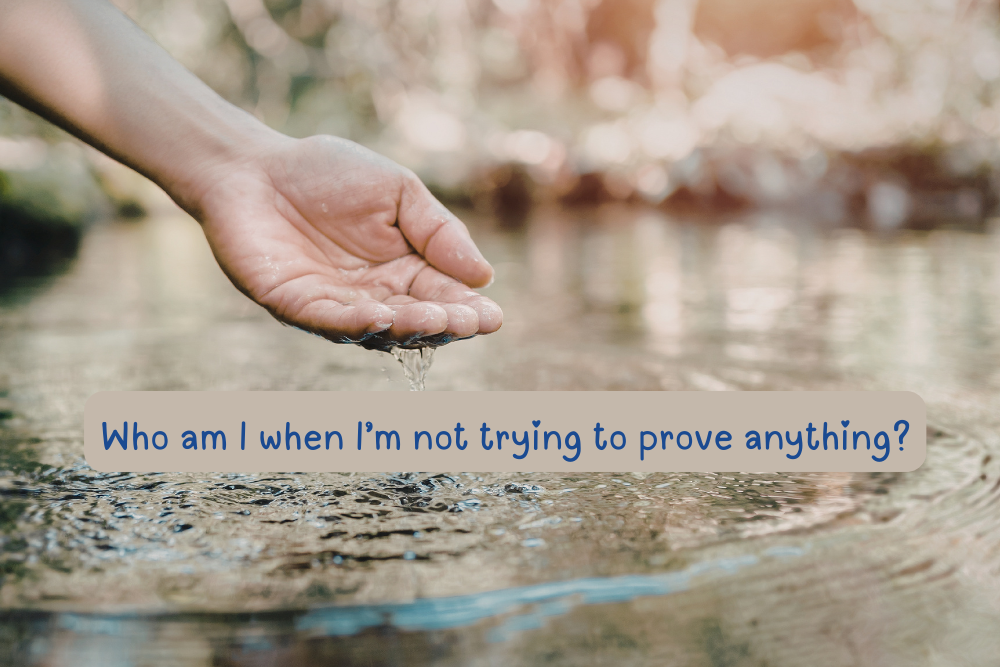
Here’s a simple somatic practice for reconnecting you with your worth, not based on achievement, but on who you are.
- Set aside a few quiet minutes where you won’t be interrupted. Sit comfortably and allow your feet to rest on the ground. Let your spine lengthen without forcing it. Take a slow breath in through your nose and exhale gently through your mouth.
- Now bring your attention to your body. Notice where you feel tension or holding. Perhaps your shoulders are lifted, your jaw is tight, or your stomach feels braced. Without trying to change anything, simply acknowledge what’s there.
- Then place one hand on your chest or your belly. Let the warmth of your hand create a small point of connection. As you breathe, allow your body to soften just a little.
- Quietly ask yourself: Who am I when I’m not trying to prove anything?
- Let the question land in your body rather than searching for an intellectual answer. Notice what shifts. You may feel a sense of space, emotion, resistance, or even relief.
All of this is information you can use to give your nervous system a different experience, one where you can exist without needing to earn your worth in that moment.
Over time, these moments accumulate. And something important begins to change. Self esteem in women isn’t built by doing more. It grows when the nervous system learns, little by little, that who you are is already enough.
I started paying attention to the processes and systems that created the greatest impact in my life, and I’ve outlined the most important ones in the Introduction to The Stepping Forward Program. I invite you to download your free copy today!
 Journaling Reflection Prompts
Where in your life do you most often feel that your worth is tied to performance or achievement?
What would it feel like to allow your value to exist independently of what you accomplish this week?
How might your leadership, relationships, or creativity change if you trusted your inherent worth more deeply?