


Why Is Change So Hard, And How to Support Your Body Through It
 Your nervous system is designed to keep you safe, not necessarily to ensure success. Understanding this has been eye-opening and transformational for many of my clients. I’ve heard them say so many times, “Why is change so hard?” And that thinking throws up roadblocks because it believes that discomfort, struggle, and frustration are signals to stop. But in truth, they may be signals of a very different sort, as we’ll see in a few moments.
The Surprise of Feeling Off During a Breakthrough
Perhaps you’ve experienced something similar to Ava…
She’d just accepted an incredible opportunity she’d worked years to earn, doing work she loved with people she respected. She expected to feel excited. Energized. Proud.
But instead, she couldn’t sleep. Her thoughts raced. Her chest felt tight, her stomach unsettled. She second-guessed everything. She asked me, “Why am I spiraling when this is what I’ve always wanted? Why is change so hard, especially when it's a good change?”
The thing she came to realize: her nervous system didn’t know this new life was safe yet. Even though her mind was on board with the change, her body was still catching up.
This is the often invisible, deeply human reality of meaningful transformation: change, even positive change, activates your nervous system and it’s asking for something from you...
Why Change Feels Like a Threat (Even When It’s Not)
One of the jobs of your nervous system is to protect you. It's constantly scanning for cues: Is this familiar? Predictable? Within my window of tolerance? If it’s not, your inner alarm system goes off, because anything different feels uncertain. And uncertainty can register as danger, even when your external circumstances look great.
The feeling of uncertainty may feel like a threat, so it triggers:
Fight or flight — urgency, irritability, restlessness, overworking
Freeze or fawn — shutdown, indecision, people-pleasing, emotional exhaustion
Body sensations — racing heart, digestive issues, shallow breathing, tension
It doesn’t mean you’re doing something wrong. It means your body is asking for regulation. In essence, it’s asking: “What am I supposed to do with this?” And it’s your job to tell it!
5 Ways to Support Your Nervous System During Change
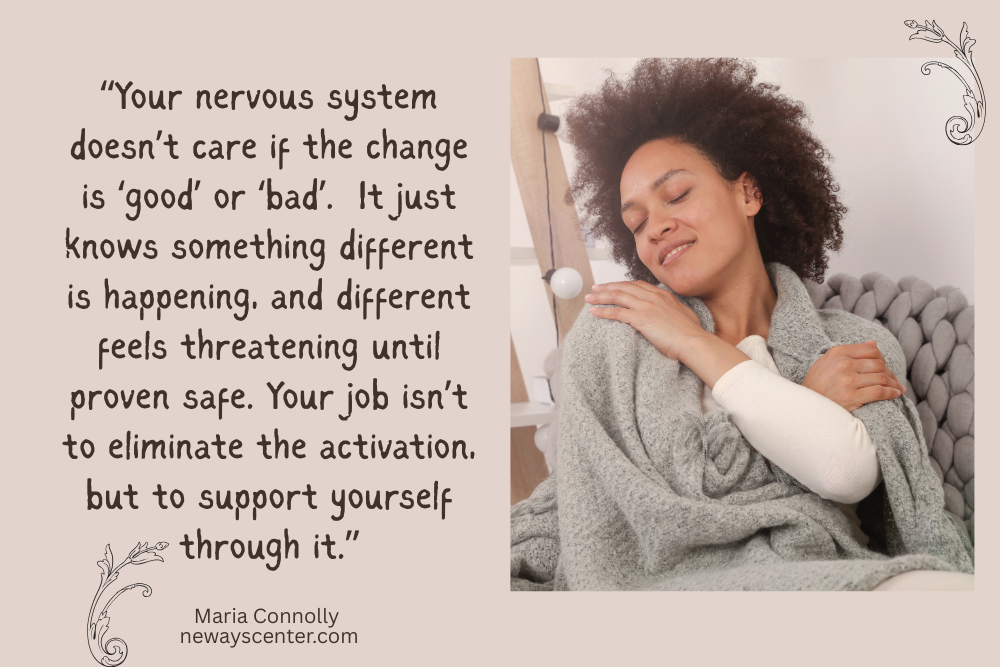
 The goal isn’t to eliminate the activation! It’s to enter into a conversation with it and reassure it, “You’re safe. We’re okay. We can keep going.” That’s how real, lasting transformation becomes embodied, not through pushing, but through supporting your body as it reorganizes. Your body needs to know how to handle the new situation, and the only way it will know is if you recognize and regulate your thoughts, emotions, and reactions throughout the new circumstance.
Instead of waiting for big moments of uncertainty, try integrating small, mindful moments of nervous system support into your day so your internal communication is well-established and open.
1. Grounding: Press your feet into the floor. Feel their weight. Notice the texture beneath you. Let gravity hold you.
2. Breathing: Try a simple 4-6 breath: inhale for 4 counts, exhale slowly for 6. Repeat five times. It signals safety to your brain.
3. Movement: Shake out your arms. Roll your shoulders. Walk slowly. Let your body discharge energy instead of storing it.
4. Safe people: Co-regulation is real. A phone call, a hug, a shared laugh — these interactions help soothe your system and restore connection.
5. Compassion: When big feelings arise, ask yourself: What does my nervous system need right now? Not: Why can’t I handle this?
The goal is not to force calm, but to offer enough safety for your body to continue moving forward.
But what can you do if your nervous system is already activated? Here’s a somatic practice that will help.
“Dream Big, Start Small.” Here's the one thing you can do today.
This mindful practice supports your body after moments of nervous system activation, whether it’s anxiety, restlessness, tension, or emotional overwhelm. It will settle and soothe your system.
1. Look around the space you’re in. Let your eyes land on 3 things that feel pleasant or neutral — a color you like, a shape, a plant, the light. Say to yourself slowly, “I am here. This moment is safe.”
2. Place one hand over your heart, and the other on your lower belly. Notice the warmth of your hands, the rhythm of your breath. Let yourself feel held by your own presence.
3. Inhale gently through your nose for a count of 4. Exhale slowly through pursed lips or a soft sigh for a count of 6. Repeat this breath cycle 4–6 times.
4. If it feels comfortable, begin to sway slightly, side to side or front to back. Rocking is a deeply regulating motion that calms the nervous system and signals safety. Stay with it for a minute or two.
5. Close by saying to yourself: “I’m allowed to slow down. I’m safe to soften. My body is adjusting, and that’s okay.” Let the practice settle into your system.
This Is the Invisible Work of Becoming
When you’re in a season of growth, things will stir in your thoughts, your emotions, and most of all, your body.
Your nervous system is doing the invisible work of adjusting, releasing, and reorganizing itself to match the new version of you that’s emerging. That process takes time, gentleness, and support.
So if you’re feeling anxious, foggy, or off-center during a change you want, take heart. This is the path. Nothing has gone wrong.
And you don’t have to navigate it alone. My EMERGE Method was created to help you honor your whole self, not just the part that knows how to keep going, but the part that needs to slow down and feel safe while everything shifts. You can learn some of my most valuable tools and how to use them in my free ebook, Introduction to Stepping Forward.