Maria Connolly, LPC Facebook Facebook Facebook

Tag: visualization

Visualize in great detail or play a movie in your mind of successful outcomes you want to achieve. Most of us visualize before we want something to happen. However, it’s much more powerful to use 90 seconds during or after an incident and visualize a successful outcome.

Remain Relaxed Even Under Pressure with these NLP Anchoring Techniques
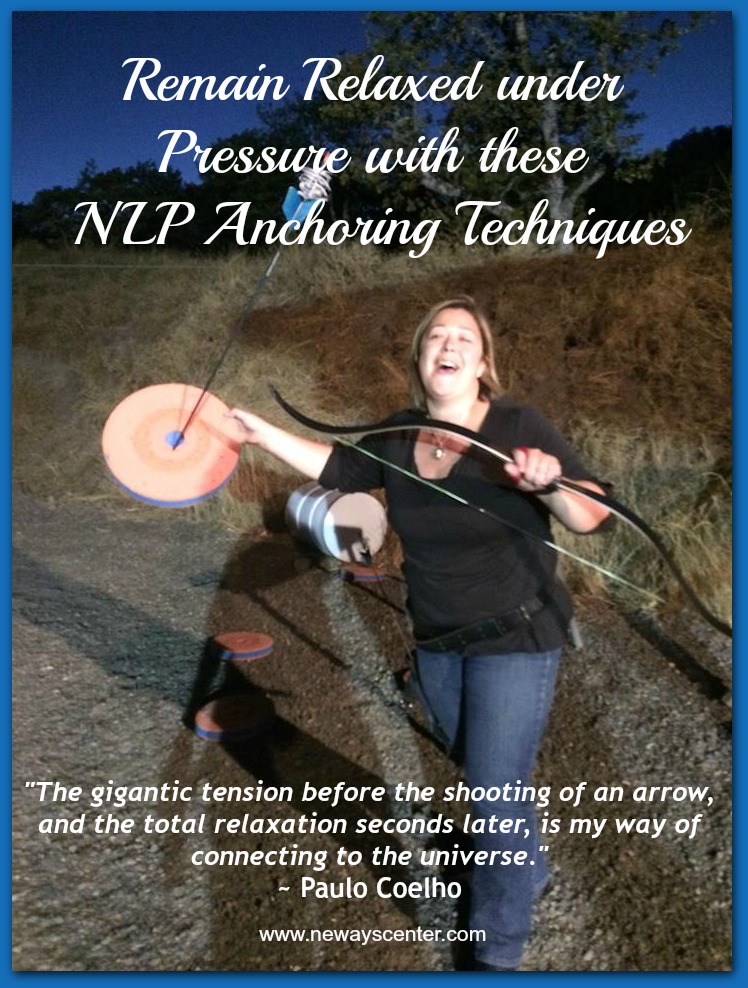
Remain Relaxed Even Under Pressure with these NLP Anchoring TechniquesStressed out. Strung out. Uptight. On edge. Tense. Nervous. People have such a hard time achieving a deeply relaxed state of mind. Any little thing can set them off, send them over the edge. This is taking a terrible toll on the emotional, mental, physical, and spiritual health of us and our loved ones.

Earlier, I shared a number of ways to achieve deep relaxation through Progressive Muscle Relaxation and simply making time for things you enjoy. (Yes, that’s me in the picture. I love archery!) As mentioned, to get the most benefit, focus on relaxation via the body, via the mind, and via the soul.

What do I mean by Deep Relaxation via the Soul?

A lot of people say that they can’t relax because their lives are chaotic and messy. It’s important to practice your ability to relax fully no matter the circumstances or the conditions around you. Neuro-Linguistic Programming (NLP) teaches us that we can choose any psychological state at will. This means that you can experience bliss, joy, gratitude, or love no matter what is happening in your life. And one of the NLP techniques that helps you do this is called “anchoring”.

In NLP, “anchoring” refers to the process of associating an internal response with some external or internal trigger so that the response may be quickly and subtly accessed.

NLP anchoring techniques are based on science. Russian scientist, Ivan Pavlov, famously demonstrated how conditioning works. He rang a bell every time dogs were fed. Soon the dogs psychologically associated the smell and taste of food with the sound of the bell. So even if the food was not present, the dogs would salivate at the sound. The bell (an external trigger) caused a real physiological response (salivation) even though the smell and taste were absent.

NLP anchoring techniques similarly cause you to psychologically associate a signal or trigger (tapping your chest, snapping a rubber band, squeezing your fingers) with a physiological response (an emotion, mood, or mental state) of your choice. When you experience a negative emotion, you can trigger a positive emotion and extinguish the negative one. This thereby allows you to choose your mood or state of mind no matter what the circumstances are.

Here are 7 Easy Steps to Anchoring a Resourceful State of Mind:

  • Decide on the state you want to anchor. For example being calm and relaxed.
  • Recall a memory or imagine a situation where you can experience the state. Make it very detailed and vivid, using all your senses.
  • When the experience is vivid and you’re in the desired state, connect it with a part of your body. For example, put your hand on your heart when the state is at its peak!
  • Now, break state by removing your hand and doing something else. Open your eyes, count down from 10 to break state and distract yourself.
  • Apply the anchor by just placing your hand on your heart and check that the required state, such as calmness or peace, occurs again.
  • You may need to repeat the anchoring process a number of times to make the experience sufficiently intense.
  • Use your new anchor in the situation where you want to experience the desired state. For example, when you’re feeling stressed during your next business meeting, place your hand on your heart and make sure it creates a sufficiently robust resourced state of calmness.

NLP anchoring techniques are really a method of deep relaxation that is best learned under the guidance of a trained professional. If you’d like to add this excellent tool to your life skills, please contact me and I’d be happy to help you finally achieve the peace you crave.

Choosing Gratitude – The Recipe for a Happier, More Meaningful Life

choosing gratitude for a happier and more meaningful life “When you realize there is nothing lacking, the whole world belongs to you.” ~ Lao Tzu

Your feelings are your choice. You can choose to feel down or you can choose gratitude, which opens your world to peace, happiness and health. Gratitude means being continually mindful of how much you’ve been given. To say you’re grateful doesn’t mean everything in your life is great all the time. It just means you can see the goodness. Yet, because our brains are hardwired to track danger and potential challenges, we aren’t primed to notice the beautiful things around us. Instead we take things, ourselves and others for granted.

It’s easier to be grateful when things are going well. But it’s harder to stay open to gratitude during depressing times, tragedies and challenges. (When the attack on Paris happened I felt so sad and powerless against the enormous tragedy. At the same time, I felt deep gratitude and blessing for how the world came together to show solidarity toward France).

What happens when you withhold gratitude?

  • You’re more subject to depression and affliction.
  • You experience greater wear and tear when life brings challenges.
  • You naturally focus on what’s bad and hard.

On the other hand, what are the benefits of choosing gratitude?

  • Gratitude shifts your focus from what you think your life lacks to the abundance you already have. 
  • Gratitude makes you happier and more resilient.
  • Gratitude strengthens relationships.
  • Gratitude improves your immune system and your health.
  • Gratitude reduces stress and depression.
  • Gratitude increases determination, optimism and energy.
  • Gratitude makes reaching your personal goals more attainable.
  • Gratitude puts situations into perspective so you don’t complain or stay stuck.
  • Gratitude lessens panic and opens up your thinking of new solutions as you see what’s still working for you.
  • Gratitude helps you learn to love and accept yourself as you are.


Feeling gratitude is good. Expressing gratitude is better. Dr. Emmons, author of the book, Thanks! How the New Science of Gratitude Can Make You Happierfound that practicing gratitude can increase your happiness levels by 25%. This means your natural happiness set-point becomes, and is sustained at, a higher level regardless of outside influences.

What’s the first step in becoming more grateful? First you must learn to recognize what you’re grateful for. Try this gratitude exercise: 1) Imagine losing the things you take for granted – your home, a relationship, your senses such as hearing and seeing, your ability to walk. How does that feel? 2) Now, imagine getting each one back again. Fully experience the gratefulness wash over you.

Next, learn to acknowledge and appreciate the goodness in your life by daily journaling a gratitude list. Here are 12 suggestions for how to do that…

  1. Open your mind by attaching appreciation for everyone you contact daily.
  2. Get a beautiful journal and pen to record your special gratitude list.
  3. Commit to a regular time each day to write in your gratitude journal.
  4. Write 10 different things you’re grateful for and describe how they make you feel.
  5. Close your journal and breathe deeply as you center yourself in your feelings.
  6. Be amazed at all the goodness you’ve been taking for granted.
  7. Reframe every negative into a positive.
  8. When something bad happens, think, “What can I learn? When I look back on this moment, what will I be grateful for?”
  9. Give one genuine compliment daily by specifically saying what you appreciate about someone or about what they’ve done.
  10. Ask someone to share your appreciation. For example, “I think this sunset is gorgeous, don’t you?”
  11. Cultivate humility to let gratitude in…accept that you need others to make your life complete.
  12. Allow yourself to be human. If you miss a journaling day, do it the next.


Gratitude is a powerful emotion for both the giver and the receiver. Yes, you must receive gratitude from others, as well as, give it. In doing so, you gift the giver with feeling capable, needed and valued.

It doesn’t happen over night but you can learn to become aware of and acknowledge everything you receive, whether good or bad, with gratitude. Contact me if you’d like to work with me in person or over skype to learn to live a more grateful and embodied life.

How to Improve Self Image and Fitness with Cutting-Edge Mental Strength Training Techniques

improve self image by mental training“A strong, positive self-image is the best possible preparation for success.” ~ Joyce Brothers

Did you know that how you see yourself in your own mind has a great impact on your fitness level? Scientists and sports coaches have found that when you imagine yourself as fit and healthy, the brain believes it, which encourages you to make choices that consistently support your self-image as a fit person. To reinforce this positive shift you can definitely benefit from mental strength training.

That’s right! To improve your physical fitness you need to strengthen your mental fitness. Why? Because mental strength training will help you shift your self-image so you are empowered to reach your potential. Imagine how your fitness will improve when you can…

  • Focus and deal with distractions. Rather than having a result-oriented focus, you’ll be able to focus on the present moment rather than becoming self-conscious.
  • Develop a fearless mindset. You know that one event doesn’t define you as a person so you’re not afraid of embarrassment or failure.
  • Control your emotions. You’ll be able to deal with setbacks and errors as you stay composed under pressure to perform.
  • Improve endurance. You’ll be able to perform at your peak for a longer period of time when you are able to work in the “zone”.
  • Find your true motivation. You’ll be able to deliver your optimal performance because you’ll be doing things for the right reasons.  


What mental training techniques can you use to create a better self-image and boost your fitness level? Here are a few techniques I like to use with my coaching clients:

Relaxation: Calming your mind and body relieves tense muscles, which is essential to allow your muscles to stretch without tearing or pulling your skeletal frame out of alignment. By relaxing and contracting mindfully through all of your muscles groups you create deeper mine/body awareness that allows you to move more freely.

Visualization: Imagine yourself enjoying the benefits of reaching your goal. Do you want to reduce one size? Visualize how great that feels…how much better your balance is…how much stronger you are…how much more stamina you have…how well your clothes fit…how happy you are with the renewed energy to take that mountain hike or play ball with the children. The more engaged you become in this, the more your brain actually believes it to be true.

Anchoring: An anchor is a preset response to a specific stimulus. To help you feel like working out, recall a time when you had an awesome workout. Visualize the experience fully, and at the peak moment set an anchor or cue that makes your brain relive this feeling each time you employ the anchor.

Reframing: Identify your unhelpful thoughts and replace them with positive statements that support a positive self-image. Remove the phrase “I should” from your vocabulary. Instead use “I can do X now, which is so much more than when I started.” Also, get rid of the all-or-nothing mentality by refusing to personalize or over-generalize each event. One event does not define who you are as a person.

Mental editing: Whether you perform an exercise routine or only picture it, you activate many of the same brain connections that link what your body does to the controlling brain impulses. It also stimulates the sympathetic nervous system, which increases the heart rate, breathing, and blood pressure. For example, Jack Nicklaus excelled because he practiced each shot in his mind before taking it.

You’ll get the best results if you enlist the assistance of a trained coach who can teach you how to do each of these techniques correctly. Mental strength training is all about taking you from where you are now and enhancing your fitness and self-image incrementally until your mind/body health transforms you into a top performer. Contact me and we’ll schedule an appointment so you can get started on your path to an excellent self-image and improved fitness.

Four Ways to Make Meal Planning and Good Eating Habits Easier

Meal planning and healthy eating habits don’t have to be too difficult or time consuming if you apply these four ways to make weekly meal planning easier.Often people say they don’t have the time to eat healthy. Our busy work schedules and family demands can make it difficult. But it is not impossible – if you have a good reason for doing so.

Why wait until a health crisis, such as a heart attack or diabetes, forces you into making changes. The risk of permanent damage isn’t worth it. How much better it is to make proactive, mindful decisions that support you in building an excellent life now. The evidence indicates that proper nutrition plays an important role in the prevention of various physical and mental health problems. A balanced mood, sustainable levels of energy and feelings of wellbeing can be cultivated by ensuring that our diet provides adequate amounts of protein, complex carbohydrates, essential fats, amino acids, vitamins and minerals and water.

So, what is your WHY? Why do you want to improve your eating habits? To prevent disease or needless pain? To have more energy so you can participate more fully in life? To see your children and grandchildren grow up? To look more attractive? Whatever your reason is, hold onto it. That vision will keep you motivated.

Once you have your reasons for improving your eating habits firmly in mind, here are four easy steps to make meal planning simpler. (Preparation is the key to success!)

1. Commit! Just decide you’re going to do it. Involve those who eat with you by asking what they do and don’t like to eat. Even children as young as five or six can be included in this discussion. When you can factor their preferences into your plans, you can avoid discouraging, negative feedback.

2. Make a cheat sheet for your shopping trip. List plenty of veggies, fruits, and protein that you want to always keep on hand in the kitchen. This list will keep you from being distracted by the candy and chips aisles at the store. It will keep you on the outside aisles of the store where the healthy food is. And remember, don’t shop when you’re hungry. The money you save by not buying junk food will allow you to splurge on more varieties of healthy food. Don’t be afraid to try something new.

3. Prepare your meals for the week on Sunday. Plan two or three recipes for dinners and use the leftovers for lunch the next day. Cut up your veggies and fruits and put them in the fridge in see-through, separate containers. This simple step makes it so much easier to build your salad, have a quick snack or prepare an easy side dish.

4. Pre-make your breakfast. Breakfast IS the most important meal of the day! You can save a lot of time by preparing yours ahead of time. Did you know you can make a big batch of green smoothies and freeze them in mason jars? The night before simply move one to the fridge and it will be ready for the next morning. Give it a shake or a stir and you’re good to go. Or you can make little egg-veggie muffins for a quick bite when your meeting is at 7am!

New habits are formed one baby step at a time. As the book, The Power of Habit, points out, often it only takes one pivotal action to interrupt the habit cycle in our brain thereby allowing us to form new habits. (If you haven’t read this book, I recommend that you do because it’s very insightful. And it’s fun to read.)

If you haven’t you received your free copy of The 7-Point Body Wellness Assessment yet, download it right now. It will help you determine the pivotal action that you need in order to create real change in your life. 

Seven Ways to Break Free from Being Too Busy

break free from being too busyWhen all is said and done: “I wish I had spent more time…”

When was the last time you sat in silence and thought deeply? Chances are you’re feeling overwhelmed as you juggle everything in your life. So you write lists and schedule calendars to get everything done. You try to keep the important things front and center, yet as the days and weeks pass, you get sidetracked by the busywork that seems to accomplish a lot, but in reality doesn’t get you closer to your goals. You’ve been sucked back into the vicious cycle of being too busy.

Being “too busy” is a symptom of the much larger condition – that of reacting to situations instead of making good choices. What can get you back on track? More lists? No! You need a solid foundation for change, and practicing mindfulness is a great way to do that. Mindfulness is the antidote to “too busy”.

Let’s examine seven ways you can replace busyness with mindfulness:

  1. Slow down, concentrate on one task, and be fully present and engaged. For example: How many tabs do you have open in your browser right now? Shut them all down except for one and fully concentrate on the information before you. Or when you converse with someone, give your entire focus to the person and listen closely to what’s said rather than looking around the room or thinking about something else.
  1. Stimulate creativity by being open to the possibilities. Your brain needs to relax to switch into its creative mode. When you’re “too busy” you’ll dismiss a new idea or opportunity as a distraction. Instead, carefully contemplate if it’s a way for you to grow and advance. If it’s not, dismiss it, or write it down for later consideration, and move on. If it is, spend time with it.
  1. Set priorities so you can engage in life more efficiently and effectively. Start each day with a review of what you want to accomplish and end each day with what you have accomplished. This will allow you to do the things you really want to do, giving you a sense of satisfaction.
  1. Build a routine that supports your health and minimizes stress. To live an incredible life, you’ll need to be committed to the wellness of mind, body, and spirit. Some people choose to stay “too busy” so they don’t have to confront or resolve issues in their lives. When you’re mindful, you enhance your ability to perceive what is experienced through your senses rather than building fear and stress over something that isn’t real, only a mistaken notion in your mind. So add one supportive activity to your routine until it becomes your habit.
  1. Renew motivation by sharpening your vision, the reason why you’re doing what you’re doing. You’ll be able to replace “I can’t” or “Why try?” with “Yes, I know I deserve to make a success of this and I have the resources to do so”. As events unfold, observe the experience instead of always engaging in it. This will increase your emotional stability and vibrancy, as well as, open up to you a full range of options.
  1. Establish good self-relations so you can think, plan, and dream. Depression and anxiety are signs that something is trying to wake up within a person. By acknowledging the purpose of a symptom, you are in a much better position to seriously reexamine your life and begin the process of living with renewed purpose. Taking time off is essential for recharging your spirit, mind and body. Even when you’re working, be sure to set boundaries and don’t be available all the time. This will help you keep your passion alive and discover your extraordinary purpose for being.
  1. Become centered through connections. Everyone needs cherished family and friends. Instead of being so focused on doing and accomplishing, mindfulness keeps you centered on being the person you want to be. Your family and friends can help keep events in perspective. At the end of life, no one ever says, “I wish I had spent more time at the office.”

Mindfulness provides access to powerful inner resources so you can change the way you see and ultimately experience each situation. It puts you in a better position to do something different. It empowers you to participate in the world at large, as you work with what arises instead of trying to escape. Is that what you desire? Are you ready to develop a more mindfulness and meaningful life? Please contact me and we can discuss the best way for you to do that.


Let's get started with 30 free minutes

I invite you to learn more about me and my coaching and counseling services. Please contact me to schedule an “It starts with you!” 30-minute complimentary consultation with me, in-person, by phone or via video consultation, so we can explore our partnership.

SCHEDULE


How to Step Forward to a Future You've Created

Discover how to replace your old, self-limiting map with a new map full of possibilities for the future

DOWNLOAD YOUR FREE INTRO TO STEPPING FORWARD TODAY!