Resolve Identity Lag: Saying Yes to the Job Before Saying Yes to the Identity
 We often say yes to a new role, then work out how to grow into the new identity it requires of us. I see this identity lag so often in high-achieving women like Jessica, one of my clients. (Not her real name.)
She recently stepped into a leadership role she’d been working toward for years. Her title was official, her responsibilities had expanded, and colleagues were looking to her for direction.
Yet in meetings, she found herself second-guessing her decisions and looking to others for reassurance. She had the experience and know-how to lead, but she hadn't fully learned to trust her own authority. She found herself doing things the way she had done them previously, even though the role asked something different of her.
As we explored what was happening beneath the surface, she began to recognize that doing a different job was all there was to it. She needed to change how she saw herself, how she occupied space, and whether she was willing to let her own knowing guide her decisions. She was finally learning to say yes to her inner authority.
Saying yes to the job before saying yes to the identity leaves a gap. We decide on paper long before we absorb what it means to live that decision. Becoming the person who can inhabit that role with presence and inner authority is an inner process, one that involves our beliefs, history, and bodies.
A New Title Doesn't Change an Old Story Automatically
 Many accomplished women have spent years developing the qualities that brought them success. — being exceptionally prepared, anticipating what others need, proving value through hard work, or making sure no one questions their competency. These patterns worked, and they may even be part of why the new position is offered.
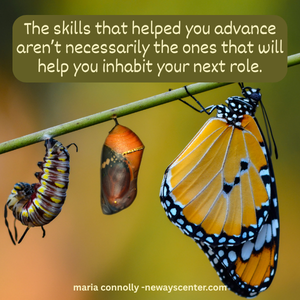
Now, something different is required. A team leader stops being the person who has every answer. Greater authority asks you to make decisions before everyone agrees. Moving from expert to leader lets others shine, allowing them to do work differently than you would. The skills that helped you advance aren’t necessarily the ones that will help you inhabit your next role.
This is where the old identity can quietly remain in charge. You have the title of director, but you still feel responsible for proving you deserve to be in the room. You have authority, but you wait for reassurance before using it. You’re expected to set direction, yet you keep looking to others to confirm that your direction is right.
It’s easy to interpret these moments as evidence that you’re not ready. However, an alternative interpretation is that you’re in the process of updating how you understand yourself.
Your old ways of being don’t disappear because your circumstances change. They carry the weight of experience, relationships, expectations, and the ways you learned to stay safe and succeed. A new role can bring these patterns into view, especially when the expectations of your position begin to exceed the identity you have been living from.
Your Body Is Part of the Transition
We experience our identity physically. Think about what happens when you enter a room where you’re expected to lead. Perhaps your shoulders tighten, your breath becomes shallow, or you lean forward as if you need to work harder to establish your place. You may speak quickly, fill every silence, or carefully explain decisions that don’t require defending.
These responses are worth noticing. They reflect familiar ways of managing uncertainty, seeking approval, or protecting your place in a group. They don’t mean you are incapable of leading. They offer information about what’s happening as you step into unfamiliar territory.
Somatic work invites you to become curious about these responses rather than automatically acting from them. You begin to recognize the difference between the part of you that knows what you’re capable of and the part that still feels compelled to prove it.
That distinction can change how you lead. Instead of rushing to demonstrate competence, you might pause to listen. Instead of taking back a task because someone approaches it differently, you might allow them to find their own way. Instead of waiting for certainty, you make a considered decision and remain open to what you learn.
These are opportunities to develop a different relationship with yourself, one in which you can act from inner authority without needing every moment to confirm your worth.
Let Yourself Grow Into the Role
Resolving the identity lag means allowing your understanding of yourself to grow alongside your responsibilities. Honor the woman who worked hard, earned trust, and learned to navigate difficult situations without asking her to lead every moment of your next chapter.
You may need to redefine what being responsible means, what competence looks like, or how you want to use your authority. You may need to become more comfortable with being seen before you feel completely settled. And you may need to recognize that leadership doesn’t mean doing more. Rather, you create room for others, tolerate uncertainty, or trust a decision without rehearsing every possible objection.
Identity develops through experience. Each time you make a choice that reflects the leader you’re becoming, you experience that identity from the inside. You’re evolving to meet the life and leadership you have chosen.
“Dream Big, Start Small.” Here's the one thing you can do today.

Because there’s always an identity lag when we start a new job or role, we need to practice our new identity. This somatic exercise will help…find a comfortable position, seated or standing, and take a moment to notice the support beneath you. Allow your breathing to settle without forcing it to change.
Bring to mind a role you currently hold or one you’re preparing to step into. Notice how you experience yourself when you think about it. Do you feel grounded, hesitant, energized, tense, or some combination? Where do you notice those feelings in your body?
Now consider the version of yourself who has been successful up to this point. What has she learned to do well? Perhaps she prepares carefully, works hard, anticipates problems, or makes herself indispensable. Acknowledge what these qualities have made possible for you.
Next, imagine yourself inhabiting this role with greater inner authority… imagine yourself listening without rushing, deciding without overexplaining, or allowing someone else to take responsibility. Notice your posture, breathing, gaze, and the way you occupy space.
What feels different? What feels unfamiliar? Stay curious about both.
 Choose one small action that reflects your emerging identity, like allowing a pause before responding, expressing your perspective without softening it unnecessarily, or delegating a task. I invite you to learn how Somatic Coaching can help you tune into what your body is telling you and how you can give it exactly what it needs, when it needs it. Please contact me and schedule a 30-minute complimentary consultation to see if we’re a good fit for each other.
Journaling Reflection Prompts
What do I believe a person in my role should know, do, or be able to handle?
What am I ready to stop carrying, proving, or managing to lead differently?
What is one small choice I can make this week that reflects the leader I am becoming?