


The Advantage of An Embodied Center. Why Centering Practices Aren’t Enough.
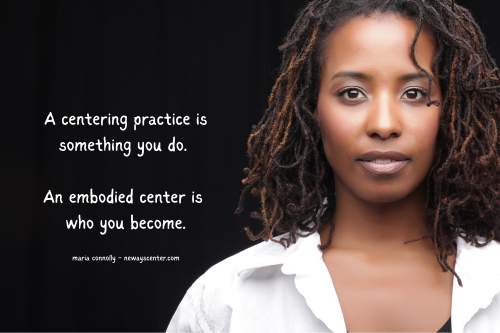 This may surprise you: There’s a vast difference between having centering practices and being a centered person. A centering practice can regulate your nervous system for a few minutes. An embodied center changes who you are under pressure. A centering practice is something you do. An embodied center is how you live.
What happened to my client, Laura (not her real name), illustrates this well.
Before an important meeting, Laura worked through her centering practices. She set her intention first thing that morning, meditated on how she wanted to display leadership presence, and stretched her body to be physically and emotionally flexible. She even did her breathing exercise outside the conference room door. She felt centered.
Then someone questioned her proposal. She felt the familiar tightening in her chest. Her shoulders lifted. Her breathing became shallow. Before she realized what was happening, she was speaking faster, defending herself, and saying things she wished she'd phrased differently.
Driving home, she wondered, What happened? I was centered this morning.
The answer wasn't that her centering practices had failed. They had helped her find her center, but what she hadn’t developed yet was how to maintain an embodied center.
Many of us know how to return to ourselves when conditions are quiet. The deeper work is learning to stay connected to ourselves when life isn't. It’s easy to lose yourself in the distractions of life: a difficult conversation, an overflowing inbox, or a family member needs your attention. Before long, you're rushing from one responsibility to the next without ever pausing to notice what’s happening inside.
For many high-achieving women, this becomes so familiar that feeling rushed, scattered, or slightly disconnected starts to feel normal. We assume we need more time, better organization, or greater discipline. What we really need is to come back to our center.
The more you return to yourself, the more your embodied center grows and strengthens.
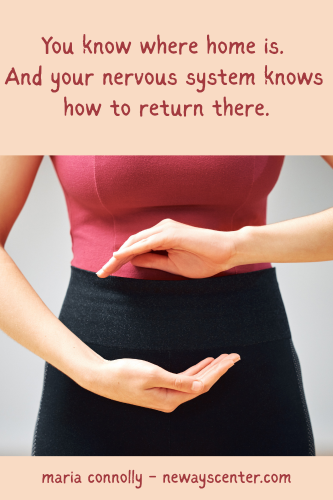 Instead of repeatedly losing yourself and trying to find your way back, you begin carrying your center into whatever the day brings. Of course, you still feel disappointment and uncertainty. People can still push your buttons. But you can mindfully observe without judgment, then recover more quickly because your body is no longer experiencing every challenge as something that pulls you away from yourself.
The Misconceptions About Centering
One of the biggest misconceptions about embodiment is thinking of your center as a destination. Embodiment reveals that your center is home. You don't visit your home once in the morning and hope it lasts all day. You live there. When you leave, you know exactly where to return.
Compounding this misconception is the belief that the goal is to stay centered all the time. That’s not possible. Life pulls you in many directions every day, so you’re going to be in and out of center all day long.
The goal isn't to avoid becoming off center. Maintaining your center means you recognize when you’re off balance sooner, so you can gently find your way back. We want little sways, not wild, out-of-control swings.
What My Own Practices Have Taught Me
Over the years, I've discovered that some of my greatest teachers are embodied practices.
My daily Feldenkrais practice deepened my understanding of my center. Through slow, mindful movement, I notice patterns of effort I didn't even realize I was carrying. As unnecessary tension releases, my body reorganizes itself into something more efficient, more grounded, and more alive.
I practiced Aikido, a martial art, whose name means "the way of harmony." Every class reminded me that force isn't the answer. When I became tense or rigid, I lost my balance. When I softened and returned to my center, everything became more fluid.
Archery became another teacher. When I draw the bow, the target isn't the only thing requiring my attention. My breath, my posture, my balance, and my presence all matter just as much as where the arrow lands.
From there, I learned horseback archery, where horse, rider, bow, and arrow must work together as one integrated system. It's impossible to force that kind of harmony. It can only emerge when I am fully present.
I also learned a lot about the power of engaging my center before making a move from CrossFit training and competition. Most recently, paddleboarding has been teaching me not to be distracted, but to be fully present and centered, or I’ll land in the lake.
You might think all of these are just sports or recreation, and if I weren’t attuned to myself somatically, that might be all they are. As I am constantly using them to connect with and return to myself more consistently, they have become invaluable in helping me develop an embodied center.
Each practice is different. Each returns me to the same place, my center.
Your Body Already Knows the Way Back
 You don't need to practice martial arts or learn archery to cultivate your center. Your body offers opportunities every day.
- Every time you pause before responding.
- Every time you notice your breathing.
- Every time you soften your shoulders instead of carrying another hour of tension.
- Every time you recognize you've been rushing and choose to slow your next step.
These ordinary moments become extraordinary because they remind your nervous system that safety comes from staying connected to yourself, not from controlling everything around you. Small moments, practiced consistently, reshape how you meet your life.
“Dream Big, Start Small.” Here's the one thing you can do today.

Rather than staying still, try bringing your awareness into movement. Choose a quiet place where you can walk ten to fifteen slow steps.
As you begin walking, resist the urge to arrive anywhere. Instead, notice how each foot meets the ground.
- Can you feel your weight transferring from one leg to the other?
- What happens in your hips as you shift your balance?
- Are you leaning forward into the next step, or allowing your body to move from a place of steadiness?
Now, slow down just a little more. As you walk, silently repeat: "Here." With each step, let the word remind you to return to this moment, this breath, this body.
Notice what changes. After this exercise, many people discover they aren't simply walking differently. They're relating to themselves differently. I invite you to learn how Somatic Coaching can help you tune in to what your body is telling you and how you can give it exactly what it needs, when it needs it.
 Journaling Reflection Prompts
Where do I most often lose my center during an ordinary day?
What physical sensations let me know I'm becoming disconnected from myself before my mind notices?
If returning to my center became more important than staying in control, what might change in the way I lead my life?