


Are Your Life Goals Aimed High Enough?

Does it seem like your life goals are a moving target you never seem to hit? There’s always a lot of talk about setting life goals and achieving life goals. But the more important conversation centers around this question – are you setting the right goals?
Rather than settling for what’s comfortable and easily within your range, it’s also important to ask, How do I know that I’m aiming high enough, without making it unrealistically impossible to achieve? As Michaelangelo said:
“The greater danger for most of us lies not in setting our aim too high and falling short; but in setting our aim too low, and achieving our mark.”
Because you’re always growing, moving forward, learning new skills, gaining strength in certain areas, your life goals may shift and keep moving, depending on the stage of life you’re at. So it takes skill to keep your focus and achieve what’s truly important to you.
Archery is one of my favorite activities and I often think about how it’s a great metaphor for achieving your fullest potential in life. Each stage of drawing the bow and releasing the arrow mirrors how we approach life goals.
Is Your Vision Bold Enough for the Life You Want?
Lesson #1: Without a target, there’s no purpose.
If I handed you a bow and arrow, your first instinct would be to ask, “What do I shoot at?”
A clear target changes everything. Suddenly you have purpose. You feel excitement, challenge, and possibility. The same is true of your life goals. Without them, your energy scatters. You may stay busy, but directionless. With a target, each day has meaning and focus.
 Lesson #2: Anchor yourself for success.
In archery, anchoring means drawing the bowstring to the same fixed point – your cheek or jaw – every time. This creates stability, accuracy, and trust in your shot.
In life, anchoring means centering yourself before chasing your goals. When you connect with your body and inner truth, you align with what matters most, not what the world tells you to want.
This kind of grounding builds resilience. It keeps you from wobbling when setbacks happen.
Lesson #3: Aim high for the long-term
When you first learn archery, you set your target close. But as you grow, you move the target farther away. To hit it, you must lift your aim higher than the bullseye to compensate for gravity.
Life goals work the same way. If you only aim for what feels certain, you’ll stay small. When you lift your sights higher, beyond your current limits, you grow. Even if you miss the first time, you’ve stretched into new capacity.
Lesson #4: Measure your progress
No archer expects to hit the bullseye on the first try. Just hitting the target is progress. Each ring becomes a marker of improvement.
In life, specific and measurable goals give you feedback. They help you see where you’ve grown and where you can adjust. Without measurement, it’s easy to dismiss progress and stay stuck in “not enough.” With it, you build momentum.
Lesson #5 Partner up for accountability
Joining an archery club keeps you consistent. You show up, learn from others, and stay motivated.
The same is true in life. An accountability partner, coach, or trusted peer makes you more likely to follow through when motivation dips. They remind you that aiming high doesn’t have to be a solo journey.
“Dream Big, Start Small.” Here's the one thing you can do today.
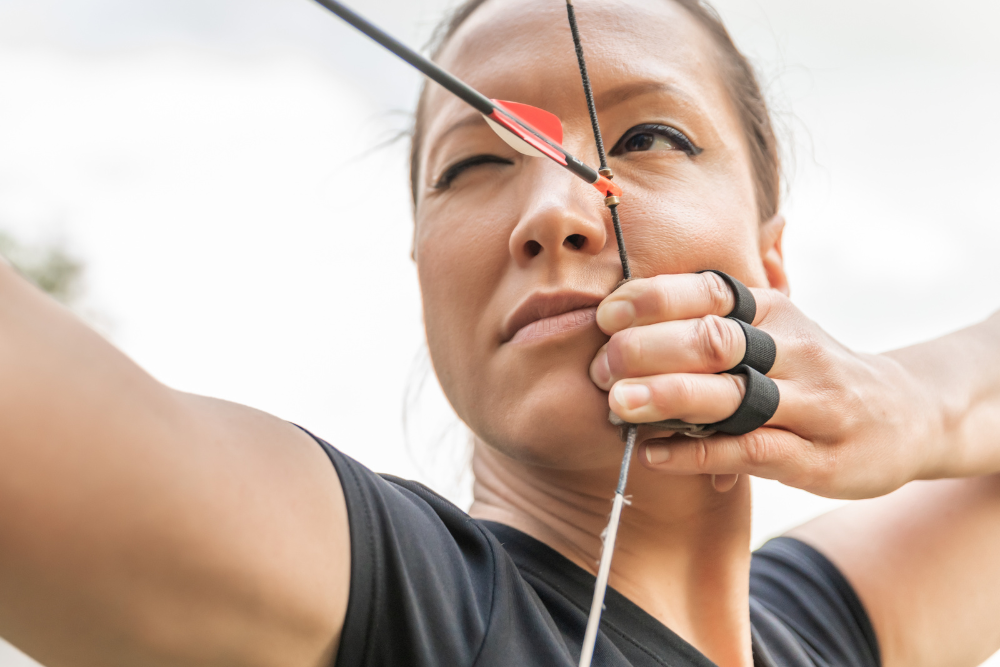
Here’s a somatic exercise that will help you connect the act of anchoring and breathing with a goal, so you feel the goal in your body instead of just thinking about it.
Name your goal. Be specific, answering the questions: who, what, where, when, why.
Take your stance. Sit or stand with your feet firmly on the ground, hips and shoulders relaxed. Imagine you are stepping up to the archery line.
Practice the archery breath. Inhale slowly through your nose, imagining you’re drawing back a bowstring. Feel your chest expand and your body gather energy. Pause briefly at the top of the breath, the moment of clarity and focus. Exhale steadily through your mouth, releasing the “arrow”. Feel how your body changes as your “goal” moves out into the world.
Anchor the experience. Sense where in your body the goal “lives.” Is it a lightness in your chest? A fire in your belly? A steadiness in your spine?
Close with presence. Whisper: “This goal is not just an idea. It lives in me. I carry it forward from here.”
This practice turns a goal from a mental checklist into something felt and embodied. Each time you revisit it, you anchor your intention not only in thought, but also in breath, posture, and presence, aligning your whole self with the path forward.
When you practice embodiment, you value, motivate, and bring out the best in yourself and the people around you, which can leave a lasting impact. So what kind of impact will you make? If you’d like to explore this further, download my free report, 10 Steps to an Embodied Practice.
Reflective Journal Prompts
 If I set aside others’ expectations, what target would light me up right now?
What practices help me feel most anchored and connected before I take aim at a big goal?
Where in my life am I aiming too low for fear of missing, and what would it look like to raise my sights?
How can I measure progress in a way that fuels me, rather than discourages me?
Who in my life can encourage me to keep aiming high, and how can I invite them into my goal-setting process?