


Rooted in Origins: How to Build Inner Authority on a Strong and Flexible Foundation
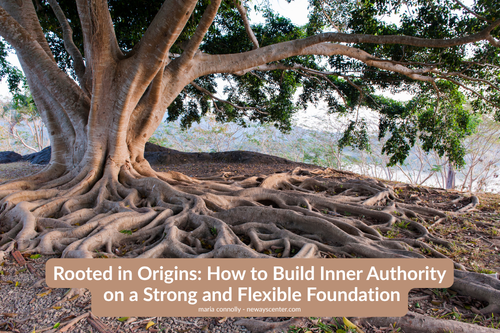 You can be highly accomplished and still not feel fully at home in your own authority. On the other hand, when you’re rooted in origins, you know who you are and where you stand. Let’s explore what this means and how it works in practical terms…
You know your work, have years of experience, and you’re the get-it-done person when something important needs to happen. And yet, when someone questions your decision, walks into the room with more power, or asks you to step into unfamiliar territory, you may notice yourself becoming more rigid, more careful, or more determined to prove yourself. There's a gap between knowing how to lead and staying connected to yourself while you do it.
Often, we assume the answer is to build more confidence, become more decisive, or learn another leadership strategy. But what’s missing is the deeper work of becoming more grounded in what you know to be true about yourself. That’s where being rooted in origins begins.
This requires looking back in a very intentional way: We want to use it as a source of information, and we do this by suspending judgment.
Rooted In Origins
Our origins aren’t just stories of where we came from. They’re part of the ground from which we learned to move through the world. The ways we learned to relate, work, succeed, handle conflict, seek approval, and take care of others became patterns for handling relationships, decisions, and leadership.
These patterns may be particularly difficult to recognize because they often look like strengths. Strengths like being responsible, capable, independent, perceptive, and able to handle almost anything. Yet these strengths may also become our blind spots.
This is where origins become important. To become more fully ourselves, we look to understand what shaped us, where we’re coming from, and which unhelpful parts of that history we’re still carrying unnecessarily. When we see those patterns clearly and integrate them into our understanding of ourselves, we become rooted in origins.
But here are two common misconceptions about being rooted…it doesn’t mean being rigid or stuck.
Rootedness Is Not Being Stuck
 Being rooted doesn't mean hanging on to what has always been. There’s a significant difference between being rooted in your history and being defined by it.
Perhaps you grew up learning that you could depend only on yourself. You became the woman who handles things, solves problems, and rarely asks for help. Maybe you learned to read other people's moods and needs because it helped you fit in with your family. Now you’re highly attuned to others, but here’s the downside: you take responsibility for things that aren't yours. Or perhaps you learned early that achievement brought recognition and belonging, and you carry that lesson into every room you enter.
We may say, “This is just who I am.” However, what we’re calling our personality has roots in what we learned we needed to be. It’s a learned behavior, not who we are or want to be.
Understanding this gives you more choice about how you use your strengths. You can remain capable without always being the one who takes charge. You can care deeply about others without anticipating every need. You can value achievement without expecting achievement to make you feel enough.
Rootedness allows you to hold your history without being held captive by it.
Your Roots Give You Range
 Think about a tree with deep roots. Its roots provide stability, but they allow a great deal of movement. The tree can bend in the wind, reach toward the light, lose branches, grow in new directions, and respond to changing conditions because it has a strong place from which to grow.
Our leadership can develop in much the same way.
When you have a settled relationship with where you come from, you don't have to defend yourself every time someone disagrees with you. You can listen without immediately trying to convince the other person. Or change your mind without feeling that you’ve lost yourself. You can enter a room where you’re not the expert and remain curious rather than feeling diminished. And you can be you without apology.
You can explore this in your own leadership by paying attention to what happens when you feel uncertain or challenged. Maybe your first response is to explain. You offer more details, provide more evidence, and make sure everyone understands your reasoning. Perhaps you become quiet and wait for someone else to establish what’s acceptable. Or you become determined to hold your position because changing your mind feels too much like losing ground.
Rather than judging these responses, become curious about them. They may have served an important purpose at another time in your life. The question is whether they still serve you now.
There is often a small space between noticing an old response and acting on it. Turn that space into a pause, because that’s where choice becomes possible. You might still decide to speak firmly, hold your position, or take charge. The difference is that you’re making that choice from the woman you are today rather than automatically responding from what you once learned you had to do.
This is part of what makes inner authority different from simply being confident. Inner authority is the capacity to stay connected to yourself while you listen, respond, reconsider, and make decisions. You can be clear about what matters to you while remaining open to what you may not yet know.
When we are rooted, we can have more range. We can adapt without abandoning ourselves.
“Dream Big, Start Small.” Here's the one thing you can do today.

The next time you’re facing a difficult decision or conversation, pause before moving into action. Put both feet on the floor and notice the support beneath you. Look around the room and allow yourself to arrive where you actually are.
Bring the situation to mind and notice, without judgment or change, what happens in your body. Perhaps your shoulders tighten, your breathing changes, your stomach contracts, or you feel an urge to explain, withdraw, take control, or make the discomfort disappear.
Then ask yourself, “Is this how I want to respond now, or is this something I learned long ago?”
Take a breath and feel your feet again. Then ask, “What becomes possible when I trust myself enough to remain open?”
You may not receive an immediate answer. The practice is about creating enough space to recognize that you have choices.
From Rooted In Origins to Leading With Inner Authority
Your roots are not there to keep you in one place. They give you somewhere to stand as you grow, change, take risks, and become more fully yourself. Going back to your origins doesn’t make you more attached to the past. It frees you to become more fully yourself.
When we understand what shaped us, we distinguish between the qualities that are genuinely ours and the roles we learned to play. We appreciate the resilience, determination, sensitivity, and competence that helped us become who we are while deciding whether the strategies behind those strengths still belong in the life we’re living.
This is the movement from Rooted in Origins to Rising in Wholeness to Inner Authority. We look honestly at where we come from. We make room for more of who we are. And as we become more whole, we no longer need to look outside ourselves for permission to trust what we know.
If you’ve enjoyed this article, I invite you to sign up for my free monthly newsletter.