


Five Breathing Practices for Balancing Your Life, Your Mood, and Your Relationships
 There’s a rhythm to everything we do. There’s an ebb and flow to life that consists of taking and giving, picking up and letting go. Our breathing follows a rhythm, too, one that responds to all that we experience throughout our lives.
What does your breathing reveal about the quality of your life?
Your life experience creates a breathing pattern within you. Your breathing is connected to your nervous system, and it gives clues about how you’re experiencing the world around you. When you become more aware of your breath, you also have an opportunity to notice the physical patterns that accompany your thoughts, emotions, and everyday interactions.
It’s worth paying attention to how often during the day your breathing feels calm and rhythmic compared to feeling erratic and rushed.
Five Breathing Practices to Feel Present, Balanced, and Connected
Breathing practices can help you pause, become more mindfully present in your body, and explore different ways of responding to what life brings. When you do them, try not to control your breath or force yourself to relax. This is an opportunity to become curious about your body and what it’s communicating.
Breathing Practice 1
 Many of us have spent years overlooking our physical responses because our attention is directed toward everything happening around us.
- Find a comfortable seated position with your feet resting on the floor.
- Let your shoulders settle and allow your hands to rest comfortably.
- Bring your attention to your breathing without deliberately changing its rhythm.
- Notice where you feel the movement. Is it in your chest, ribs, abdomen, or somewhere else?
- Notice whether your breathing feels easy, restricted, shallow, or uneven.
- Pay attention to any tension in your jaw, neck, shoulders, or abdomen.
- Stay with these observations for a minute or two.
This practice helps you recognize your body's responses without judging them or feeling that you need to fix something.
Breathing Practice 2
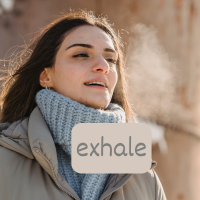 When life feels demanding, you may notice that your breathing becomes quicker or that you hold your breath without realizing it. Allowing your exhale to become slightly longer than your inhale can be a useful way to explore a slower breathing rhythm.
- Sit comfortably and let your body feel supported.
- Inhale gently through your nose for a comfortable count of three.
- Exhale slowly for a count of four or five, without pushing the air out.
- Allow the next inhale to arrive naturally.
- Repeat for several breaths, keeping the rhythm comfortable.
- If counting feels distracting, let go of the numbers and simply allow your exhale to last a little longer.
Notice what happens in your body. Do your shoulders soften? Does your jaw release? Does your attention begin to settle? You’re not looking for any particular result.
Breathing Practice 3
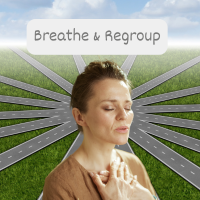 When your mind is occupied with everything that needs to happen next, it’s difficult to feel present. This practice brings your attention to your breathing and your physical connection with the ground beneath you.
- Sit in a chair with both feet resting comfortably on the floor.
- Notice the sensation of your feet making contact with the ground.
- Feel the support of the chair beneath you.
- As you breathe naturally, bring your attention to the movement of your ribs and abdomen.
- With each exhale, notice the weight of your body being supported by the chair and floor.
- Continue for a minute or two, allowing your attention to move between your breath and the physical support beneath you.
This practice is especially helpful when you feel pulled in several directions. Rather than immediately moving on to the next task, you give yourself a moment to recognize where you are and how you're feeling.
Breathing Practice 4
 When you include intentions in your breathing practice, you give your breath something meaningful to return to. Instead of simply taking deep breaths, you bring your attention to words that reflect how you want to feel or what you want to make room for.
- Take three long, deep breaths.
- Keep your focus by saying, “breathe in slowly, deeply”.
- Exhale thoroughly.
- Keep your focus by saying, “Breathe out fully, smile, feel peace/courage/strong/connection/forgiveness/etc”.
- Repeat.
This is powerful because an intention gives you a way to pause and reconnect with yourself.
Breathing Practice 5
 Yoga alternate nostril breathing brings your attention to the present moment so you can step away from the mental activity of your day.
- Exhale completely, using both nostrils.
- Press your finger against your right nostril, closing it completely.
- Inhale slowly and smoothly through the left nostril only.
- Hold that inhaled breath for a few comfortable seconds.
- Then close the left nostril and exhale through the right nostril.
- Hold while comfortable.
- Inhale through the right nostril only.
- Release your left nostril and close off the right.
- Exhale through the left nostril. Hold.
- Keep switching between left and right nostrils as you inhale and exhale rhythmically for a total of 10 to 15 sets.
- Go back to breathing through both nostrils.
What Breathing Practices Can Teach You About Yourself
Breathing practices are useful, but their greatest value may be what they help you notice beyond the breath itself.
Perhaps you recognize that your breathing changes whenever someone questions a decision you've made. Maybe you notice that you hold your breath when you’re waiting for someone else's approval or that your body tightens when you feel obligated to say yes.
These observations can help you recognize patterns that have become so familiar you rarely question them. You begin to see the connection between what happens around you, how your body responds, and the choices you make afterward.
This is an important part of developing inner authority. You learn to include your body's experience in the way you understand yourself and navigate your life.
You might start with one breathing practice each day, perhaps before a meeting, after a difficult conversation, or when you notice yourself rushing toward the next responsibility. Over time, these small moments of awareness can help you recognize your patterns and create more room for conscious choices.
I invite you to learn how Somatic Coaching can help you tune into what your body is telling you and how you can give it exactly what it needs, when it needs it. Feel free to contact me and schedule a 30-minute complimentary consultation by phone or via Zoom to see if we’re a good fit for each other.
 Journaling Reflection Prompts
When do I notice myself holding my breath?
Are there particular situations or relationships that change how I breathe?
How does my new breathing practice change the way I react to situations?