


How Failure Leads to Success When You Know this Olympic Secret

Are you drawn to the Olympics? There’s something captivating about watching an athlete stand at the starting line after years of training, setbacks, injuries, and near misses. We see the medal moment. We rarely see the quiet failures that shaped it. Yet, these winners have learned to live the mindset that every failure leads to success. How can we tap into this same Olympic secret?
We know how failure feels in our bodies. It’s a heavyhearted feeling that makes us sink, shrink, and pull in. It’s sweaty palms, nauseous stomach, and heat that radiates from our core to our face. Too often, we relive the embarrassment and discouragement over and over again. Therefore, many people try to avoid failure at all costs.
For high-achieving women today, failure feels more intense than it did even a few years ago. The stakes feel higher. The pace is faster. Social media amplifies comparison. The economy feels uncertain. Leadership roles carry more scrutiny. Many women are juggling business, caregiving, partnerships, and personal growth all at once.
In this climate, failure can feel less like a stepping stone and more like proof that you should have known better.
But this Olympic secret still applies: failure leads to success because failure is simply data. It’s not identity.
Elite performers understand something essential. They don’t collapse into failure, and they don’t deny it. They metabolize it. They allow it to refine them.
An interesting example of how failure leads to success is that of Lex Gillette. He’s a silver and gold medal-winning long jumper for the U.S.A. And he’s completely blind! Before each competition, he and his coach walk the length of the runway and the sand pit so he can build a mental map. During the jump, his coach guides him with clapping and cries of “Fly, Fly, Fly” until he reaches the spring board. (Watch it here.)
He hasn’t gotten to where he is without his share of failures. And he makes this interesting observation,
“Failing at something is essential. You go through some sort of hardship, and it helps catapult you to a higher level. I’ve had a number of failures in my life, and I’ve been able to tap into that inner strength in order to come back and be resilient. I see failures as stepping stones and things that I’ve had to do to get to my destination.”
In his case, failure leads to success because each mistake refines his inner map. And he’s not the only Olympian who says that. A study interviewed 10 Olympic gold medalists and found that they all consider failure to be essential to winning their gold medals. “The majority of participants stated that if they had not underperformed at a previous Olympics, they would not have won their gold medals.”
Why Failure Leads to Success
Michelle Segar, a motivation scientist and director of the Sport, Health, and Activity Research and Policy Center at the University of Michigan, noted that once a person fails, “you don’t have that fear over your head anymore, then you can really focus.”
And research on high performers consistently shows that those who succeed do two things differently.
- First, they focus on why the situation created distress rather than ruminating on the emotion itself.
- Second, they create psychological distance from the event. They treat it as feedback, not a verdict.
That distance isn’t coldness. It’s embodied awareness. It’s resilience.
 Resilience is not pretending something didn’t hurt. It’s the capacity to stay present with discomfort long enough to extract the lesson without absorbing shame.
In today’s world, many women experience failure in subtle but relentless ways. A launch that doesn’t convert. A conversation that goes poorly. A boundary that wobbles. A leadership decision that receives pushback. We internalize it quickly, “I should be further along. I should have handled that better. Maybe I’m not cut out for this.”
When you can say, “That presentation didn’t land the way I hoped. My chest feels tight. I feel embarrassed,” you’re naming the experience without becoming it.
However, when failure remains a purely mental loop, it spirals. Your nervous system registers it as a threat. You either go into overdrive to compensate or you shut down to protect yourself. Neither state produces growth.
This is where embodiment becomes essential. When you involve the body and listen to what it’s trying to tell you, something shifts.
“Dream Big, Start Small.” Here's the one thing you can do today.
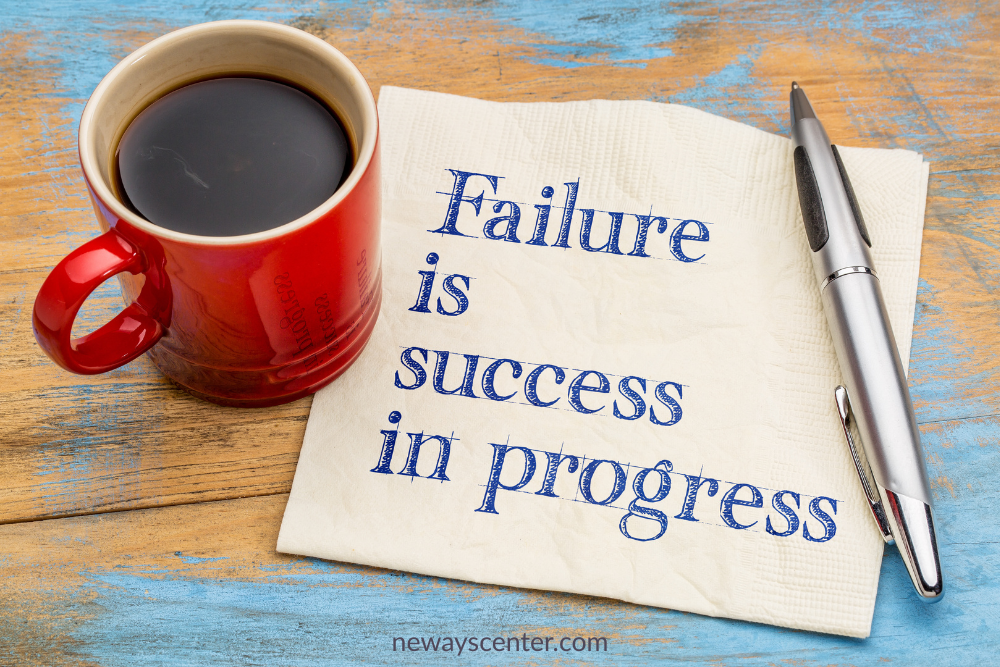
Here’s how you can process failure in real time. When something doesn’t go as planned, try this within the first hour.
First, sit upright with both feet flat on the floor. Feel the ground beneath you.
Take a slow breath in through your nose for four counts. Exhale for six. Do this five times.
Now bring your attention to where you feel the failure in your body. Is it a heaviness in your stomach? A tightness in your throat? Heat in your face?
Place one hand gently over that area if it feels comfortable.
Instead of asking, “Why did I mess this up?” ask, “What is this sensation trying to protect me from?”
Stay curious.
Often, you will uncover something deeper than the event itself. Fear of rejection. Fear of being seen as incompetent. Fear of not belonging.
Now, gently shift your posture. Lengthen your spine. Roll your shoulders back. Lift your chin slightly. This is not performance. It’s signaling safety and capability to your nervous system.
Finally, ask one grounded question: “What is one specific adjustment I can make next time?” One adjustment. Not a complete overhaul of your identity.
In less than five minutes, you have acknowledged the emotion, regulated your body, and extracted learning. That is resilience in action.
The surprising truth is this: avoiding failure actually weakens your nervous system. It keeps you fragile. When you allow yourself to experience setbacks and consciously process them, you build capacity. You become less reactive and more deliberate.
Failure then becomes less dramatic. More instructional. That’s how failure leads to success.
The only true failure is disengagement. Failing to prepare, failing to reflect, failing to learn. Giving up because the emotional discomfort feels intolerable.
But emotional discomfort is survivable. Especially when you know how to work with it.
Today’s world requires a different kind of strength. Not the grind-it-out mentality. Not the curated perfection. It requires women who can feel disappointment without collapsing, recalibrate without self-attack, and continue forward with clarity.
Mastering your inner game is what allows you to lead, create, and love with courage. Every misstep can either confirm your fears or expand your capacity. The difference isn’t talent. It’s your relationship with the experience.
In my EMERGE Method, growth is not about striving; it’s about unfolding into your fullest expression with clarity and purpose. When you recognize your defining moments, you see that your evolution has always been guided by an inner wisdom that knows when to shift, release, and rise. Would you like to learn more about how my EMERGE Method can help you grow all of your intelligences? Contact me and let’s talk.
 Journaling Reflection Prompts
Think of a recent setback. What meaning did you automatically assign to it about yourself? Is that meaning objectively true, or is it an old narrative resurfacing?
Where do you tend to feel failure in your body, and what does that sensation seem to be protecting you from?
If you viewed your current challenge as training rather than proof of inadequacy, what specific skill or capacity might it be strengthening in you?