


Sustainable Ways to Work WITH Your Body to Deal with Accumulated Stress
 She burst into tears in the grocery store parking lot. Nothing dramatic had happened. No bad phone call. Just one more headline. One more unexpected expense. One more decision. “It feels like everything’s working against me. Even my body!” Ellen said. “I feel flat and completely exhausted.” If that sounds familiar, please hear this first: there is nothing wrong with you. What you may be experiencing is collective stress, the accumulated strain of living in uncertain times where the pressure is not just personal, but cultural, economic, and relational. Yes, your nervous system is activated, but you can learn to work WITH your body, to not only cope, but thrive.
We’re living in a time of rapid change, real uncertainty, and information overload. For many women — especially leaders, caregivers, and entrepreneurs — there’s the added weight of responsibility. Holding families… teams… and communities together.
So, of course, your system is activated, oscillating between hypervigilance and shutdown. That isn’t dysfunction. That’s your biology trying to protect you.
To cope, we may resort to inadequate coping skills. We push through or numb out. We try to think more positively. We take a break and then brace ourselves to re-enter the noise. But those strategies keep us in a cycle of override.
The nervous system has one primary job: to keep you safe. It constantly scans for threats, both physical and psychological. Your system interprets overwhelm as potential danger. It mobilizes (anxiety, urgency, racing thoughts) or conserves (fatigue, numbness, withdrawal). Neither response is wrong. They’re intelligent adaptations.
The problem begins when we try to override them.
Learning To Work WITH Your Body
Working WITH your body is different. It’s sustainable because your body knows how it needs to be. You learn to mindfully recognize that it's responding exactly as it was designed to respond to perceived threat and instability.
When we partner with our body instead of trying to outthink it, we build real capacity — a grounded strength that enables us to stay present even when the world feels unsteady.
Fixing vs. Befriending Your Nervous System
Many self-help approaches imply that if you were more evolved, more mindful, more positive, you’d simply “calm down.” But “just calm down” doesn’t work. Why? Dysregulation isn’t a mindset problem. It’s a physiological state. You can’t think your way out of a stress response that lives in your tissues.
Trying to control or suppress your nervous system often increases internal conflict. It sends the message that your body is inconvenient or untrustworthy.
Befriending your nervous system is different. Befriending means acknowledging: “Of course I feel this way. Something in me is responding to uncertainty.” Instead of asking, “How do I stop this?” you ask, “What does my body need right now?”
 That subtle shift changes everything, because now you’re working WITH your body!
When someone says “calm down,” your nervous system hears: “You’re not safe as you are.” But here’s the thing: safety isn’t created through pressure. It’s created through cues. Your body regulates through:
- Slower breathing
- Steady eye contact
- Gentle movement
- Physical contact with supportive surfaces
- Predictable rhythms
- Connection with another regulated human
These are biological signals of safety. The goal isn’t to eliminate activation, but to build capacity for feeling activation without being overwhelmed by it.
Recognizing Current Threat vs. Old Patterns
During accumulated stress, it’s common for old survival patterns to get activated. Here’s a helpful distinction:
Current reality response feels specific and time-bound. If you read concerning news and feel tense for a few minutes, that’s a present-moment stress response.
Old pattern response feels global and familiar. If the news triggers a spiral of “Nothing is safe. I’m alone. I can’t handle this,” that may be an older imprint layered on top.
Neither response is wrong. But awareness gives you choice. You can gently ask yourself: “Is my body responding to something happening right now, or to something it remembers?”
Simple Practices That Let You Work WITH Your Body
For her later appointment, I met Ellen in the parking lot. When ya person is anxious or shut down, the brain is already overloaded, so she didn’t need explanations. She needed something simple enough to do in the car, where her anxiety always seems worse.
So I asked her to press her feet firmly into the floor of her car. “Really press,” I said. “For twenty seconds.”
At first, she laughed. Then she did it. She felt the solid resistance of the car beneath her shoes. The simple pressure created feedback in her muscles and joints. Her body registered something steady and supportive. She wasn’t floating in catastrophe. She was sitting in a seat, feet on the ground.
Next, we shifted her breath. Not dramatic deep breathing. Just a small adjustment. Inhale for four. Exhale for six. Again. Inhale for four. Exhale for six. The longer exhale began to cue her parasympathetic nervous system, the branch responsible for settling and regulation. Within a minute, her shoulders dropped.
Then I asked her to look around and name five neutral objects she could see. “A lamp post,” she said. “A blue SUV. Clouds. A tree. A street sign.”
She tuned into what was actually there. This is called orienting. It tells your nervous system, “Look. Right now, in this moment, you’re not under immediate attack.” It gently brings you out of imagined futures and back into present reality.
 Finally, I invited her to place one hand on her chest and one on her abdomen. Not to force calm. Just to feel contact. Warmth. Containment. The simple pressure of her own hands created a subtle signal of safety. After about two minutes, she sighed. Not a dramatic breakthrough. Just a shift.
She later told me that what surprised her most wasn’t that the practices worked. It was that they worked without her having to fix anything. She didn’t need to solve the economy or stop reading the news forever. Nor did she need to analyze her childhood. She just needed to meet her nervous system where it was.
That became her new coping strategy. Instead of asking, “What’s wrong with me?” she began asking, “What does my body need right now?”
Some days, the answer was movement. A brisk walk to discharge anxious energy. Some days, it was stillness. Sitting on the edge of her bed with her feet on the floor before starting work. Some days, she limited input. Not as avoidance, but as stewardship of her capacity.
Over time, she noticed something powerful. She was no longer afraid of the oscillation between hypervigilance and shutdown. She recognized it as a response, not an identity. And that changed everything.
When you learn to work with your body during collective stress, you become responsive instead of reactive. You build micro-moments of regulation throughout the day so your system doesn’t have to swing so far in either direction. You’re reminding your nervous system that you’re supported and resourceful. And from that place, you can choose your next step with far more clarity and power than panic or collapse could ever provide.
“Dream Big, Start Small.” Here's the one thing you can do today.
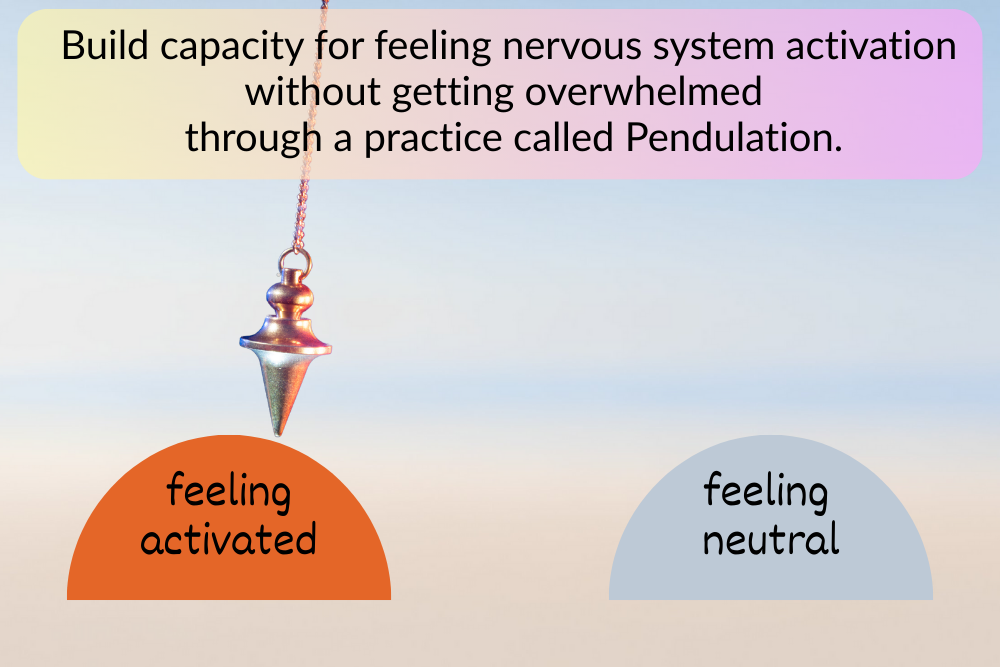
When your nervous system feels activated, build capacity for feeling it without getting overwhelmed by it through a practice called Pendulation. This exercise helps you move between activation and safety without getting stuck.
- Sit comfortably. Notice where your body feels tense or activated. (Jaw, neck, shoulders, hands, and stomach are common areas.) Don’t analyze. Just locate it.
- Now shift your attention to a part of your body that feels neutral or steady. Maybe your feet or back.
- Stay with the steady area for 20 to 30 seconds.
- Then gently return your awareness to the activated area for 10 to 15 seconds.
- Then back to the steady area.
You’re teaching your nervous system that activation and safety can coexist and move between them. This builds resilience not by eliminating stress, but by increasing flexibility.
Working With Your Body Leads To An Embodied Presence
Embodied presence is the practice of staying connected to your internal experience while remaining oriented to the world around you. It’s not dissociation, where you leave your body to cope. Or spiritual bypassing, where you override fear with forced positivity. Nor is it collapse, where you shut down and disappear.
Embodied presence is the quiet strength of being with yourself while life is happening. You notice your breath, your tension, your emotions, while staying aware of what is actually in front of you. When you practice this, you send your nervous system a powerful message: I am here, aware, and okay. That message alone is deeply regulating.
In times of accumulated stress, reclaiming embodied presence becomes more than a personal wellness strategy. It’s a form of grounded leadership because nervous systems co-regulate. Your steadiness influences your children, your clients, your colleagues, and your partner.
Be in relationship with your body instead of fighting it. Your nervous system is your friend and is giving you an opportunity to partner with it, to listen, to respond wisely, and to lead from a place that is both human and strong. If you’d like to dig deeper into embodiment, feel free to download my ebook, 10 Steps to An Embodied Practice.
 Journaling Reflection Prompts
When I feel dysregulated lately, do I move toward controlling myself or befriending my nervous system?
How can I tell the difference between responding to current events and reacting to older patterns in my body?
What is one small, consistent cue of safety I can practice daily to build my capacity to stay present during uncertainty?