


How Our Personal History Continues To Live Inside Us Today
 “Maria, why do I do the things I do, even if I don’t want to?” It seems like inevitably all of my clients ask me this question at some point during our sessions. A lot of our work together is examining their personal history and identifying how it has formed their life patterns today.
Because of this, I’m always on the lookout for ways of explaining how our origins have influenced us. So when I was reading Saba Hasanie's new book, The Blueprint to Leadership, and saw, "Patterns are history in motion" it stopped me, partly because of where I was sitting.
I'm writing this from the bedroom I grew up in, in Northern Italy. It's 5:30 in the morning, the coffee is excellent, and the house is quiet. My mother and brother are still asleep. This apartment was small, and five of us lived in it. Back home in Oregon, I share a much roomier house with my husband and a cat.
Standing in this room, I can feel the difference in my body before I can name it. Growing up here, I learned to read the air: who was in which room, what a silence meant, how much space I could take up. Nobody taught me this. The space did.
The anthropologist Edward T. Hall coined the word proxemics for how we use and experience distance. Our sense of what's close, what's crowded, and what's private is learned, and it varies across cultures and households. It becomes our baseline, we feel like "this is how the world is." As a result, we carry those expectations physically. What feels spacious to one person can feel exposed to another. What feels comfortably close to one person can feel intrusive to another.
I was born in Sydney, raised in Italy, and settled in the American West, so I've lived inside three different assumptions about personal space, and each one felt like the only one.
That's what I love about Hasanie's phrase. A life pattern isn't a flaw to fix. It's history that kept moving: an intelligent, even protective response to a real environment that is still running long after the environment has changed. The alertness I can still feel in my shoulders is a pattern like that. It made sense here. It just doesn't need to run the show anymore.
Many of us carry a tension like this. One part learned to shrink for safety, reading the room before entering it. Another part longs to be bigger, to speak up and take up room. Both are true, and both are us. I see it often in the leaders I work with: the protective pattern and the longing to expand, living side by side in the same body.
Under pressure, we reach for what our early spaces taught us: to shrink, to scan the room, to take up space or give it away. Mindful awareness doesn't erase the pattern, but it creates a little space between the old pattern and the next choice.
“Dream Big, Start Small.” Here's the one thing you can do today.
Since our patterns of living today are born from our history, use this exercise to notice your patterns in motion. Begin by sitting somewhere you feel comfortable. Notice how your body is meeting the space around you.
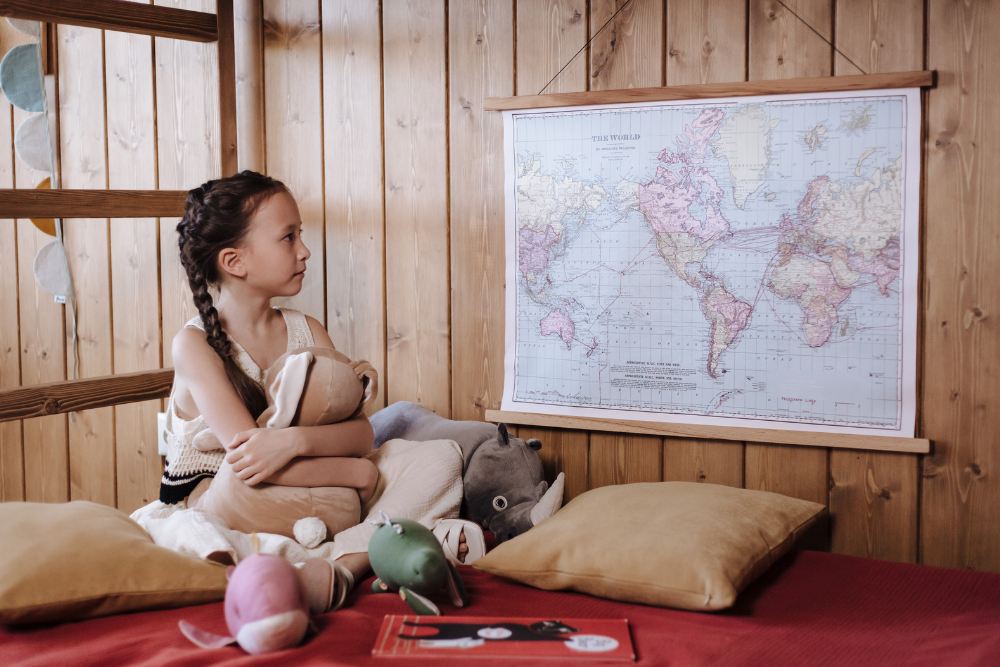
Now bring to mind a room from your early years. It might be a bedroom, kitchen, living room, classroom, or another place where you spent a great deal of time. Without trying to analyze what happened there, remember the physical space. Was it crowded or spacious? Quiet or busy? Private or shared? Did you have a place that felt like your own?
Notice what happens in your body as you remember it. Do your shoulders draw in? Does your breath become smaller or deeper? Do you feel an impulse to become very still, move away, take up more room, or pay closer attention to what is happening around you? Notice what your body learned to do in that environment.
Now look around the room you’re in today. Notice the space available to you. Feel your feet on the floor and the support of the chair beneath you. Let yourself take up the amount of space that feels right. You might gently lengthen your spine, soften your shoulders, or allow your breath to become a little fuller.
Ask yourself quietly: Is the response I learned then still needed today?
You don't need to force an answer. This practice is noticing that the pattern exists, recognizing when it appears, and discovering that you have more than one possible response now.
This morning, I can sit in this small room, hold space for the girl who lived here, and enjoy my coffee. No air to read. Just morning.
If you’ve enjoyed this article, I invite you to sign up for my free newsletter so you’ll have access, in your inbox, to everything I write.
 Journaling Reflection Prompts
What did the physical spaces of my early life teach my body about taking up space?
Where did I learn to make myself smaller, quieter, more watchful, or more accommodating?
Where did I learn that taking up space was welcomed or expected?
Where in my life am I ready to let history inform me without allowing it to decide for me?