


The Professional and The Lake: It Tests Your Presence of Mind AND Body
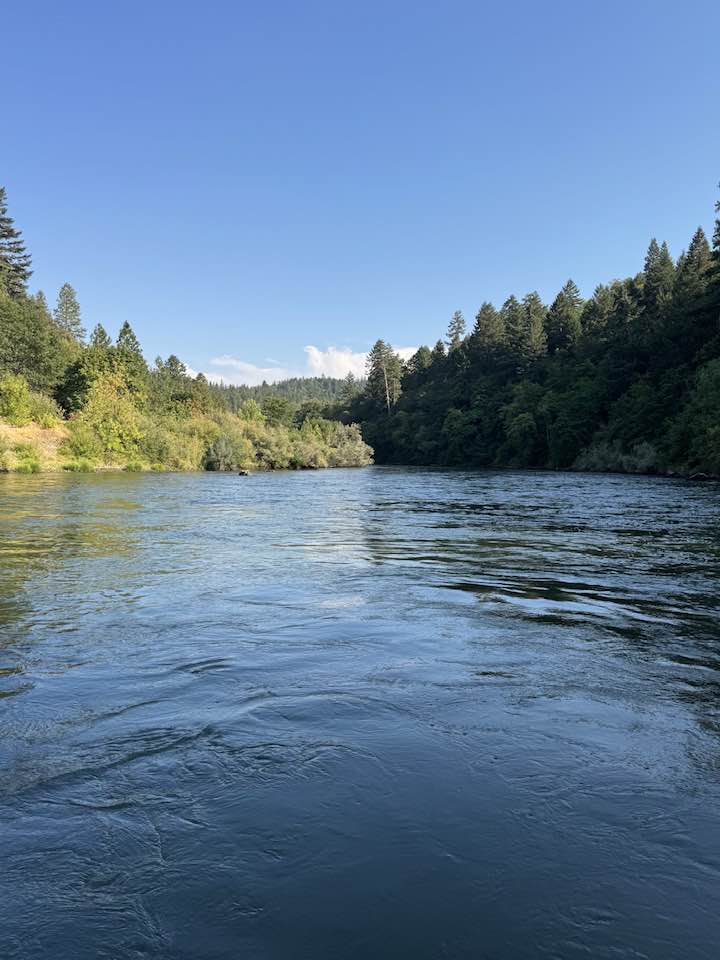 Today, I’m doing something new and different. I’m not writing to teach or “showcase my expertise” as the marketing gurus claim we ought to always be doing. Today I’m writing for the pure joy of writing about something I love. (It’s only fair, since I’ve been encouraging you to do things just for the fun of it.) I’m being vulnerable and revealing a part of myself that few people ever get to see.
I love the warm days of spring. There’s a beguiling quality of afternoon light, the air carrying just enough softness to make you look up from whatever you're doing and feel it. And immediately, almost involuntarily, I think of the lake.
My paddleboard is calling… like it does every spring… not loudly, not urgently, just persistently. A quiet pull in the direction of open water, of mornings that smell like possibility, of that specific combination of sky and stillness that only exists in the middle of a lake when you've paddled far enough from shore.
However, the water is still cold and the season hasn't fully opened, so I'm anticipating it with a low hum of happy impatience that is its own small joy.
And in that anticipation, I find myself thinking about what the lake has already taught me. About what I discover every single time I push away from shore and the water opens up around me.
The Lake Isn’t Impressed With My Credentials
Most of the time, I sit. I'm not gliding across the lake in some graceful display of balance and athletic prowess. I'm sitting, cross-legged or on my knees, paddling at my own unhurried pace, watching the light move on the water, going nowhere in particular.
Sometimes I stand. And when I do, I feel a surge of something so disproportionate to the achievement that it almost makes me laugh. I'm standing. On a board. On a lake. Like a person who can do this.
And then sometimes I wobble, and I sit back down. I've been doing this for a while now. I am not getting dramatically better. And I go back every chance I get.
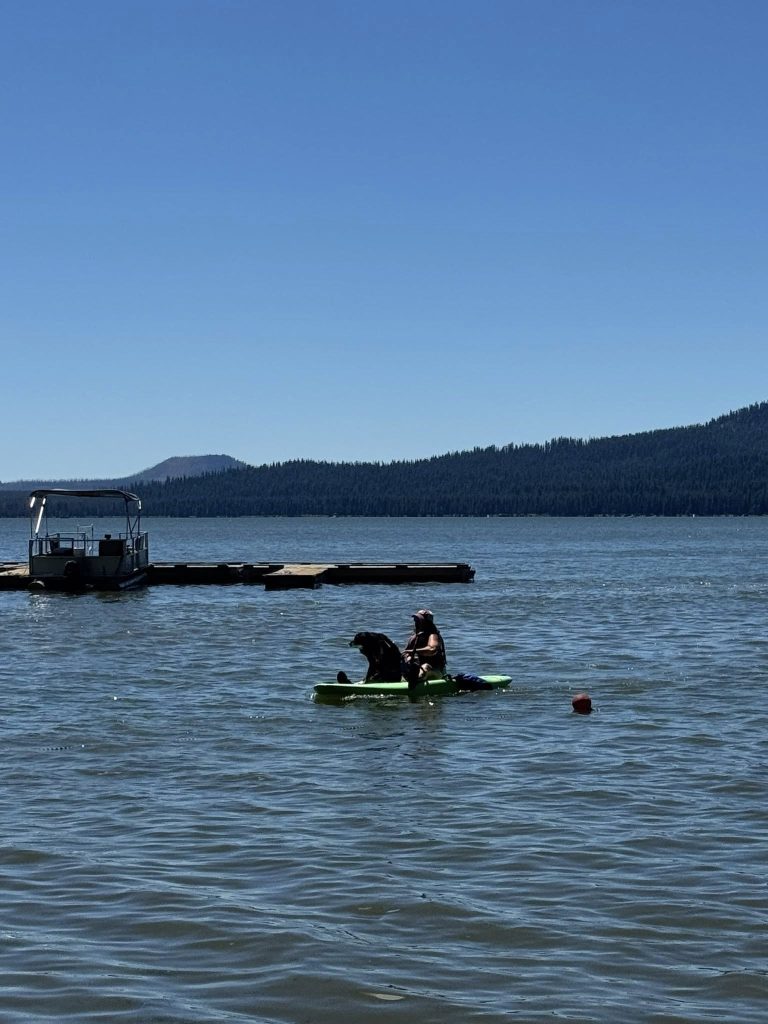 Here is something I've noticed: the water doesn't care.
It doesn't know that I've spent over twenty years studying the body, the psyche, the subtle architecture of how women hold themselves back and how they break free. It doesn't know I've sat with hundreds of women in their most tender, most transformative moments. It doesn't know my certifications, my years of experience, my areas of specialty.
The water just asks: Are you here?
And then it asks it again. And again. Every shift of weight, every gust of wind, every small wave from a passing boat… Are you here? Are you actually here, in this body, on this board, right now?
You cannot fake an answer. That's the thing about balance. It's one of the most honest feedback systems available to the human body. You either are, or you aren't. You either find it or you don't. And if you're somewhere else in your head or body, the board will tell you immediately, without judgment, without cruelty, without softening the information.
This is one of the most freeing experiences of my life.
What Becomes Possible When You're Not the Expert
As a coach, I love holding space for others, offering perspective, tracking what's true beneath what's spoken — this work is a privilege and a joy. But it has a weight and its own special kind of exhaustion. The weight of competence, of being the steady one, the clear one, the one who can see what others can't yet see.
The paddleboard doesn't want any of that from me. On the water, I’m simply a woman who mostly sits and is occasionally delighted to stand. I’m a beginner in the truest sense — not performing beginner-ness as a teaching tool, not modeling vulnerability strategically, but actually, genuinely not knowing what I'm doing and going anyway. Something in me exhales every single time.
I think we underestimate what it costs women to be competent. To always be capable, always be holding something together, always be the one with answers or support or steadiness to offer.
And I think we underestimate the value of doing something where none of that competence is available to you. Where the only currency is your actual presence, right now, in your actual body, with the actual water.
Joy lives there. Not the joy of achievement. The joy of aliveness.
When I Go Alone
 When I go alone, the lake is a different place entirely. There's no one to check in with. No one to stay close to or keep pace with or make sure is having a good time.
Just the sound of the water and a unique silence that lives in the middle of a lake, away from shore, where the world is held back by distance, and the only thing that matters is what's in front of you.
I find myself breathing differently out there. Slower. Lower. Like something I've been holding, without knowing I was holding it, finally gets to put itself down.
This is freedom. Just an afternoon, a board, and water that holds me without asking anything of me in return.
Women don't get enough of this. Space that is genuinely ours — not because we've carved it out of obligation, not because we've justified it as self-care or recovery or strategic rest, but because we've simply gone to the lake because the lake was calling and we answered. That act of answering that call is its own kind of sovereignty.
When I Go With Someone
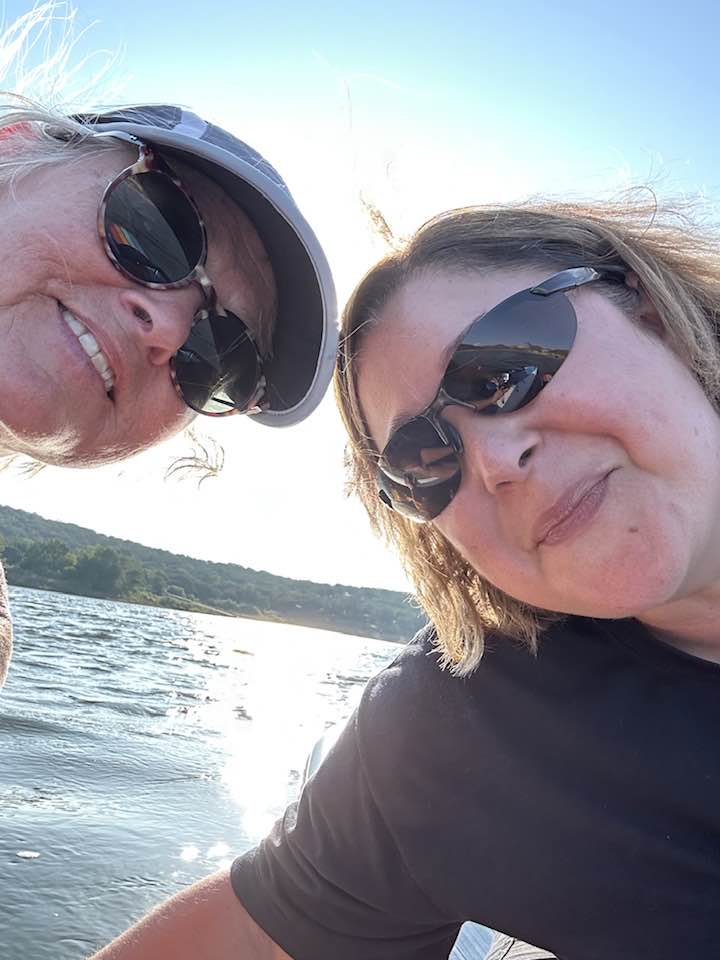 And then there are the times I bring someone with me. The lake doesn't change. The boards don't change. But everything else does.
There's laughter. There's the particular pleasure of being witnessed in your wobbling, of watching someone else's wobble, of the strange intimacy that happens when two people are both just trying to stay upright in the same body of water. Pretense evaporates. Expertise evaporates. You're just two humans doing something slightly absurd together, and it's wonderful.
I've noticed that some of my most real conversations have happened on water. Maybe because there's nowhere to hide. Maybe because the body is too busy paying attention to balance to maintain its usual social vigilance. Maybe because something about the openness of a lake invites a different kind of openness in us.
Same lake. Same board. Completely different gift.
The Day the Wind Won
And then there was last summer. I went out with a friend. It was one of those glorious, still mornings that lure you into a false sense of meteorological security. We paddled out farther than usual, feeling genuinely competent for once. Maybe even a little smug. And then the wind came.
Not gently. It arrived with absolute indifference to our plans, and suddenly we were facing a headwind that seemed personally motivated. We paddled. We paddled harder. We went nowhere. I sat down, paddled from my knees, and still made approximately zero progress in the direction of shore.
I would like to tell you I handled this with grace and equanimity, embodying everything I know about staying present under pressure. I did not. We were both humbled, completely and efficiently, by a lake in Oregon on an otherwise lovely summer day.
Eventually (this is the part I find both mortifying and a little wonderful), a kind stranger appeared. Another paddler who had seen our predicament came over and matter-of-factly helped us get back to shore.
I thanked him approximately seven times. He was kind about it. He had clearly done this before.
I stood on the shore afterward, wet and windblown and very much not a serene embodied expert on anything, and I laughed. Because what else do you do? The lake had made its point with remarkable efficiency: you are not in charge here. You bring your body and your willingness and your moderate competence on a good day, and the water decides the rest.
I was back out there as soon as I could be.
Why I Keep Going Back
There's a unique joy that comes from doing something difficult, imperfectly, repeatedly, because you love it. Not because you're achieving it. Not because you're making visible progress. Because something alive in you responds to this thing, and that aliveness is worth honoring.
We live in a world that tells us to quit what we're not good at. To optimize for strength, to spend our time where we get the highest return. And there's wisdom in that, but there's also something lost.
We lose tenacity. The willingness to be a beginner again tomorrow, even after the wind made a fool of you yesterday and you needed help getting home. That's real life.
What the Water Teaches
The water teaches me, every time, that presence of mind AND body isn’t something you achieve. It's something you return to. Over and over, moment by moment, sometimes gracefully and sometimes in a controlled collapse back to a sitting position.
The water teaches me that joy doesn't require mastery. That freedom doesn't require competence. That something can be fully, meaningfully yours, even when you're not good at it. Even when the wind wins.
The water teaches me that accepting help isn’t a defeat. That a kind stranger with a paddle and no agenda is one of the more generous things the universe occasionally sends your way.
And the water teaches me to come back. To feel the pull when the days get warmer. To answer it. I'm already looking forward to sitting on my board, paddling toward the middle of the lake, hoping today might be a standing day. And being completely okay if it isn't.