Maria Connolly, LPC Facebook Facebook Facebook

Category: Health and Wellness

Instead of dieting and depriving yourself, learn valuable tips on Health and Wellness as it includes every aspect of your lifestyle – your eating and drinking choices and habits, your physical activity and exercise, your mental health, and your emotional and spiritual wellbeing.

The Wheel of Life – Seven Steps to Creating a Truly Balanced Lifestyle

Introducing The Neways Wheel of Life – Find Your Balance

Find your balance because "happiness is not a matter of intensity but of balance, order, rhythm and harmnony." ~ Thomas Merton“It’s not enough to be busy; So are the ants. The question is: What are we busy about?” ~ Henry David Thoreau

Work-Life Balance…can it really exist? There are millions of people searching for the answer to work-life balance. Since the issue of balance usually arises when one feels that something important is missing in life, this indicates that way too many people are unhappy. And shouldn’t it really be called Life-Work Balance anyway? Life is more important isn’t it?

If you don’t mind, I’d like to ask you:

  1. How do you define balance in your life?
  2. What might it look like when your life is truly balanced?

Some people look at life-work balance as a three-legged stool that needs all three legs for balance – the legs represent their physical, mental and spiritual needs. Yet this seems to oversimplify it because within those three categories are so many areas of life. And for many people, balance involves feeling like they have TIME, but don’t we all have the same amount of time? So there’s something needed that’s much deeper than just having time.

No matter what your definition of balance is, achieving a feeling of harmonious peace and happiness is really a matter of both internal and external balance. 

If you’re internally balanced:

  • Your inner critic is in check and it operates more like a friendly coach.
  • You can methodically work on self-awareness – knowing yourself allows you to share the true you with others.
  • You have awareness of your values and always operating from them.
  • You check in periodically to make sure all inner parts are congruent and feel seen and listened to.
  • You have a balance between taking risks and stretching beyond comfort and pursuing what is quiet and familiar.

If you are externally balanced:

  • You will engage all areas of life (see The Wheel image below) that fit your lifestyle.
  • You surround yourself with social support.
  • You set boundaries.
  • You’re comfortable with saying, “NO”.

I’d like to share seven steps that you can take to achieve greater balance

  1. Define what balance is to you. Your definition will be uniquely yours.
  2. Identify your values by using percentages: 15% fun, 10% travel, 25% family…to see how much you require of each to be happy in an ideal world.
  3. Take care of basic needs: nutrition, water, sleep, exercise, vitamins and supplements.
  4. Regularly visit a supportive therapist, coach, or mentor.
  5. Make quality time for social contact.
  6. Block out “alone time” to be introspective, using mindfulness to get to know yourself more deeply – what your wants, needs, preferences, personality traits, and quirks are.
  7. Manage your energy not time! As the book, The Power of Full Engagement: Managing Energy, Not Time, Is the Key to High Performance and Personal Renewal, demonstrates, managing time is not the key. Instead, focusing on a balance of exertion and renewal helps youreach optimal performance.

Here is a tool for you to use in your quest for balance. It’s called The Neways Wheel of Life – Find Your Balance.

The Neways Wheel of Life Find Your Balance

Click here to get your downloadable, printable PDF copy of the Neways Wheel.

This Wheel of Life is designed to visually help you develop your own definition and vision of a balanced life. Each wedge represents critical aspects of life: Friends & Family, Healthy & Wellbeing, Love & Intimacy, Career, Personal Growth & Learning, Life Vision & Purpose – Spiritual Fulfillment, Fun & Leisure, and Physical Environment.

From 1 to 10 how would you rate your satisfaction in each area of the Wheel of Life? (Please print a copy of THE Wheel of Life and fill it in with where you are right now. Keep it handy and check your progress regularly.) You’ll find that your numbers will vary. And that’s a good thing. Obtaining a perfect 10 in all categories is not the goal. Balance is not static. It’s like riding a bicycle. You only remain balanced if you keep moving forward. Remember, it’s the journey that counts. We never truly get to the destination, because our definition and vision of balance changes as we change throughout the years!

No matter where you begin, all the sections of your life are interconnected, just like the wedges on the Wheel of Life. It’s simply a matter of what you want to focus on first. If you’re craving a more balanced lifestyle, it might be time to enlist the help of a life coach who can help you fully utilize your Wheel of Life. Contact me, because I would love to work with you!

15 Highly Organized Characteristics of a Leader to Create a Lifestyle You Love

Find 15 characteristics highly organized leaders cultivate in support of a busy lifestyle and learn 7 reasons why you’ll want to use them in your life too “Good order is the foundation of all things.” ~ Edmund Burke

People who focus on excellence, like leaders and business coaches, know that their best performance starts with becoming highly organized and that “Clutter is a state of mind.” A cluttered space begets a muddled mind and vice-versa.

I have a confession: I’m unusually organized. Not only do I make my bed every morning, I also find a way to tidy up and declutter as I go. I partly inherited this from my mother. I suspect her neatness was a way to cope with stress and anxiety. I’m so glad this gave me a model for creating a simpler, clutter-free environment.

Being highly organized is not only a way to create pleasant spaces but also a strategy for doing anything in life. It means being clear about what you want, being able to prioritize, setting outcomes and the respective steps to make your way to the goal.

We can’t run around stressed all the time with a million things on our mind and expect to perform at our best. So…how are you going to change your lifestyle to one that’s more organized?

Take a look at the following highly organized characteristics that leaders cultivate. (You can do the same with daily, mindful attention.)

1. Be undistracted by uncluttering your mind. Learn to work through the daily stress in a way that let’s you forget it and move on. For some, the best method is a vigorous workout. Others like yoga, walking, or talking with a friend or professional. Personally, I love Crossfit, Archery, and Aikido.

2. Be proactive. If a task takes fewer than five minutes, do it! Pick it up, wipe it down, put it away. That way work doesn’t frustratingly pile up.

3. Be goal oriented. Create an environment that makes it easy to achieve your goals. It’s easier to let things go when they’re not attached to your goals.

4. Be optimistic. The can-do attitude keeps you on track. Focus on filling your mind with the positive things you can do, even if they seem small.

5. Be decisive. Wishy-washy gets you nowhere. Consider your options, pick the best one and work it to the best of your ability without looking back.

6. Be imperfect. Don’t become immobilized in the minutia of the details. It’s never going to be perfect, so determine when it’s good enough and move on.

7. Be list, calendar, and container oriented. Make a place for everything, and put everything in its place. This applies to physical items and routinely scheduled events. You’ll know where it is when you need it and you’ll know if you have a slot open in your schedule for invitations and requests. Capturing your ideas in a detailed list of tasks frees up your mental energy. Referring to your list and calendar often keeps you on-task. This helps you foresee any potential conflicts that might interfere with your goals.

8. Be able to say, “No.” When you know exactly what you want, it’s easier to turn down invitations and requests that don’t fit into your goals.

9. Be prepared. Know how much time you have to complete a project and leave enough time, including a cushion for unexpected occurrences, to do it.

10. Be focused. Avoid multi-tasking. It’s better to protect your time by shutting out distractions and focusing on doing one task at a time.

11. Be aware of your strengths and play to them. Define how you want to live your life such as how you want your home to look, how you want to dress, how you spend your time. This makes it easier to set goals and accomplish them. Do your most taxing work when you’re alert and energized.

12. Be willing to ask for help. Trying do it all yourself only causes more stress. Respect your most valued resource – time – and use it wisely.

13. Be content. Just because you see something beautiful you don’t need to possess it. Just because it’s on sale, it’s not a good deal if you don’t really need it.

14. Be in love with what you own and do. Everything need to be cared for and maintained whether these are relationships, skills, or possessions. Streamline your focus to the place where you can thrive.

15. Be choosy. Don’t attach sentimental value to everything you own. For example, just because you inherit your parents’ furniture, it’s okay to pass it on to someone else if it doesn’t fit your lifestyle.

What I love about being highly organized is that it:

      1. Saves time in the long run,
      2. Lessens your stress because you’re not “playing catch-up”,
      3. Makes you feel better about yourself,
      4. Prepares you for everything,
      5. Empowers you to say NO to excess and say YES to what you really want,
      6. Energizes you as you stop procrastinating, and
      7. Shifts your focus from quantity to quality.

Being organized is about striving for optimal effectiveness and maximum efficiency in any task. It is about feeling more in control, about the thrill of setting things up for success. Wouldn’t you love the freedom to be exactly who you’re meant to be as you enjoy each moment of life? Becoming organized can get you there! Contact me and let’s work together on ways that empower you to make lasting change. I’m looking forward to hearing from you!

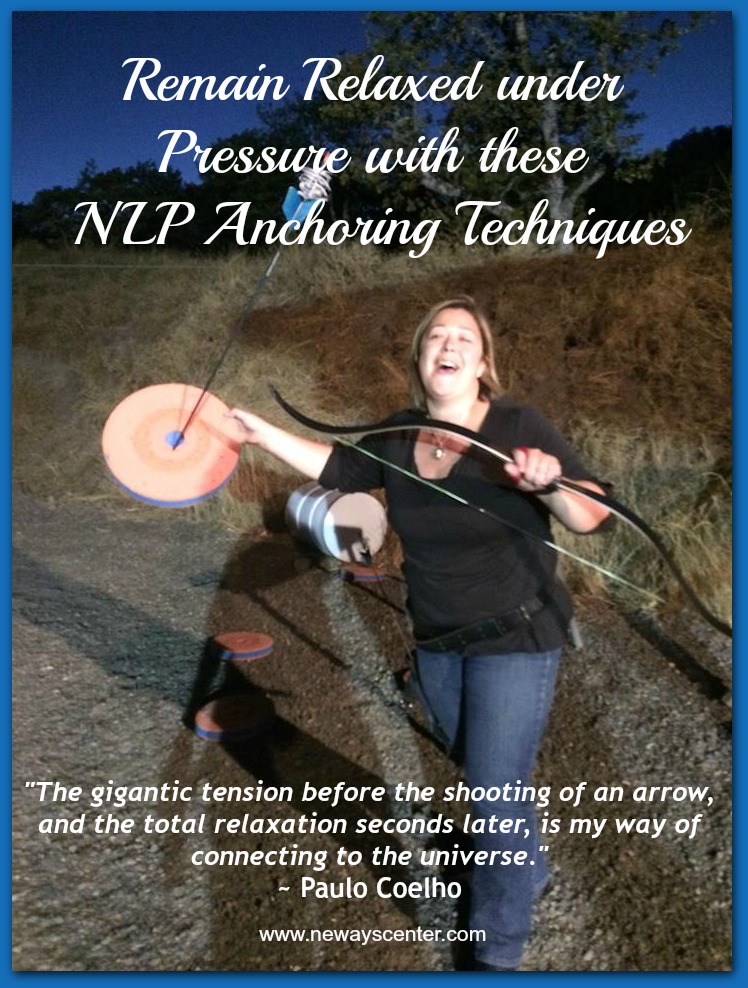
Remain Relaxed Even Under Pressure with these NLP Anchoring Techniques

Remain Relaxed Even Under Pressure with these NLP Anchoring TechniquesStressed out. Strung out. Uptight. On edge. Tense. Nervous. People have such a hard time achieving a deeply relaxed state of mind. Any little thing can set them off, send them over the edge. This is taking a terrible toll on the emotional, mental, physical, and spiritual health of us and our loved ones.

Earlier, I shared a number of ways to achieve deep relaxation through Progressive Muscle Relaxation and simply making time for things you enjoy. (Yes, that’s me in the picture. I love archery!) As mentioned, to get the most benefit, focus on relaxation via the body, via the mind, and via the soul.

What do I mean by Deep Relaxation via the Soul?

A lot of people say that they can’t relax because their lives are chaotic and messy. It’s important to practice your ability to relax fully no matter the circumstances or the conditions around you. Neuro-Linguistic Programming (NLP) teaches us that we can choose any psychological state at will. This means that you can experience bliss, joy, gratitude, or love no matter what is happening in your life. And one of the NLP techniques that helps you do this is called “anchoring”.

In NLP, “anchoring” refers to the process of associating an internal response with some external or internal trigger so that the response may be quickly and subtly accessed.

NLP anchoring techniques are based on science. Russian scientist, Ivan Pavlov, famously demonstrated how conditioning works. He rang a bell every time dogs were fed. Soon the dogs psychologically associated the smell and taste of food with the sound of the bell. So even if the food was not present, the dogs would salivate at the sound. The bell (an external trigger) caused a real physiological response (salivation) even though the smell and taste were absent.

NLP anchoring techniques similarly cause you to psychologically associate a signal or trigger (tapping your chest, snapping a rubber band, squeezing your fingers) with a physiological response (an emotion, mood, or mental state) of your choice. When you experience a negative emotion, you can trigger a positive emotion and extinguish the negative one. This thereby allows you to choose your mood or state of mind no matter what the circumstances are.

Here are 7 Easy Steps to Anchoring a Resourceful State of Mind:

  • Decide on the state you want to anchor. For example being calm and relaxed.
  • Recall a memory or imagine a situation where you can experience the state. Make it very detailed and vivid, using all your senses.
  • When the experience is vivid and you’re in the desired state, connect it with a part of your body. For example, put your hand on your heart when the state is at its peak!
  • Now, break state by removing your hand and doing something else. Open your eyes, count down from 10 to break state and distract yourself.
  • Apply the anchor by just placing your hand on your heart and check that the required state, such as calmness or peace, occurs again.
  • You may need to repeat the anchoring process a number of times to make the experience sufficiently intense.
  • Use your new anchor in the situation where you want to experience the desired state. For example, when you’re feeling stressed during your next business meeting, place your hand on your heart and make sure it creates a sufficiently robust resourced state of calmness.

NLP anchoring techniques are really a method of deep relaxation that is best learned under the guidance of a trained professional. If you’d like to add this excellent tool to your life skills, please contact me and I’d be happy to help you finally achieve the peace you crave.

Achieve Deep Relaxation through Progressive Muscle Relaxation Techniques

Deep relaxation can be achieved no matter where you are or what you’re doing if you learn these Progressive Muscle Relaxation and NLP anchoring techniques.It feels so good to deeply relax! Do you find that these moments are all too rare for you? Does the idea of relaxing at a deeper level seem illusive?

While there are no specific guidelines for how much relaxation a person should incorporate into their lifestyle, making time to unwind and enjoy life is an important part of maintaining good health. 

To get the most benefit from your periods of relaxation, strive to achieve deep relaxation via the body, via the mind, and via the soul.

1. Deep Relaxation via the Body:

Deep relaxation, like meditation, exercise and deep breathing, when practiced regularly, is shown to have many potential benefits, such as, improved mood, decreased blood pressure, alleviated stress, anxiety and pain, and improved immune and cardiovascular systems.

You can achieve deep relaxation of the body by practicing Progressive Muscle Relaxation. Here’s how:

Create a relaxed, uninterrupted atmosphere by putting on loose clothing, playing soft music, dimming the lights, and shutting off the world around you.

Sit in a comfortable chair that supports your head and back. You can also do this exercise lying down if you’re trying to get to sleep.

Taking a few deep breaths, close your eyes and clear your mind. As you breathe in slowly, visualize what’s making you tense. As you slowly breathe out, visualize that you’re releasing those feelings. Imagine that all intruding thoughts are clouds sailing over you, so they move on and don’t fill your mind.

Progressively tense and relax every area of your body. As you proceed, think about how you would describe the relaxed state. If you can associate the relaxed state with a color, word, or image, you’ll attain deep relaxation more quickly in the future.

  • Make a fist with your right hand, tightening the muscles of your hand and forearm. Count 10 seconds. Then allow your hand to open and your arm to relax as you count 10 seconds. Do the same with your left hand and arm. Feel the difference between the relaxed state and the tense state. Repeat.
  • Make a fist with your right hand, and bring it up to your shoulder, tightening your upper arm. Hold for 10 seconds. Release. Repeat with your left arm. Allow tension to flow out through your fingertips. Repeat both arms.
  • Now focus on your head. Raise your eyebrows as high as you can, hold for 10 seconds. Relax. Allow your forehead to become smooth. Repeat. Next bring your eyebrows together, as you frown deeply. Hold for 10 seconds. Relax. Repeat. Next, purse your lips into an ooh (like a monkey sounds). Hold for 10 seconds. Fully relax until your mouth falls slightly open. Next, clench your jaw tightly. Hold 10 seconds. Release. Relax fully. Repeat. 
  • Raise your shoulders toward your ears, allowing your shoulder and neck muscles to tighten. Hold for 10 seconds. Allow your shoulders to drop. Feel the tension flow down and out fingertips. Relax for 10 seconds. Repeat. Next, press the back of your head against the chair, tightening the muscles in the back of your neck. Hold 10 seconds. Relax 10 seconds. Focus on the relaxed feeling and allow it to spread throughout your neck. Repeat.
  • Move your focus to your upper back, mid-back, and abdomen. Begin by pressing your shoulder blades together. Hold for 10 seconds. Release 10 seconds. Repeat. Take a couple of deep breaths in and out, releasing any remaining tension. Next arch your lower back just enough to tense the lower back muscles. Hold 10 seconds. Release 10 seconds. Repeat. Tuck your abdomen in tightly. Hold for 10 seconds. Release 10 seconds. Repeat. Breathe deeply a couple of times to release any remaining tension.
  • Finally, focus on your buttocks and legs. First, squeeze your buttocks together, hold for 10 seconds. Release for 10 seconds. You can choose to work on your legs separately or together. Bring your legs straight out in front of you and point your toes toward your face. Tighten your calves and thighs. Hold for 10 seconds. Release for 10 seconds. Repeat. Allow tension to flow down your legs and out the bottom of your feet.

Once you complete the Progressive Muscle Relaxation routine, scan your body for areas that still feel tense. Repeat the tensing and relaxing for that muscle group. Allow yourself to stay in the relaxed state for a few moments. Open your eyes. How do you feel?

Note: When tensing the muscles, don’t over tighten a muscle to the point of pain. If you have an injury, consult your doctor or therapist to determining the best method of tensing and relaxing that muscle group.

2. Deep Relaxation via the Mind:

Making time to find enjoyment is also an important element of relaxation. Get out of your mind often and distract yourself from your worries by making room for leisure and play. After all, laughter is good medicine! It decreases pain, helps your heart and lungs, promotes muscle relaxation and reduces anxiety.

We’ll discuss Deep Relaxation via the Soul in an upcoming blog post. Many people have found that they relax more fully if a coach guides them through the steps, rather than trying to do them from written instructions. If this is true for you, contact me and we can arrange a session that works for you.

Improve Your Personal and Business Communication through Touch

Improve personal and business communication through touchAren’t you drawn to warm, affectionate people? We feel immediately comfortable with them. What is it that makes them so approachable? It might be the warmth of their smile or their eye contact with you.

However, if you pay attention, you might be surprised to find how often warm people touch others. They shake hands with firm, full palm contact…not a limp-fish handshake. They may even pat you on the shoulder as they shake your hand. Or they let their hand rest just for a moment on your forearm. Or they greet you with a side hug, knowing that a full hug seems too intimate and may make you uncomfortable. All during the conversation, they continue to communicate through touch.

Touch is our primary language of compassion. Maybe you can remember a time when you were hurting, and a trusted confidante or parent enveloped you in their arms. Your heartbeat slowed, your sobs subsided, and you were able to breathe again. Touch changed your life at that moment. You knew you were not alone. Someone was there for you.

Communication through touch is fundamental to human bonding and health. At Berkeley University of California they studied whether people can communicate compassion through touch. They built a barrier in the lab that separated two strangers. One person stuck his or her arm through the barrier and waited. The other person was given a list of emotions. He or she had to try to convey each emotion through a one-second touch to the stranger’s forearm. The person whose arm was being touched had to guess the emotion.

Remarkably, the guesses were correct nearly 60 percent of the time. They got the emotions – gratitude, anger, love, and fear – right more than 50 percent of the time. Gender seems to have a bearing on the results. Interestingly, when a woman tried to communicate anger to a man, he had no idea what she was doing. And when a man tried to communicate compassion to a woman, she didn’t understand it.

In another study these researchers found, “People can not only identify love, gratitude, and compassion from touches but can differentiate between those kinds of touch, something people haven’t done as well in studies of facial and vocal communication.”

People understand your words better if you touch them. No that doesn’t mean if you’re angry you should punch someone. However, when you’re working to keep the line of communication open enough so that you can touch them, you’ll be more mindful about controlling your emotions. As you touch them, it reminds you that you love and appreciate this person and you want to mend the rift in your relationship, which helps you calm down. And they will feel that intention despite the hurt or anger and will be more open to listening to you.

Do you see how powerful touch can become in your communication? Which do you think will have more success? Yelling at your daughter to “get in here” then standing with your hands on your hips glaring at her? Or putting your hand on her shoulder, guiding her to the couch where you can sit closely as you look her in the eye and discuss the problem earnestly?

In the office, which will create greater team spirit and employee loyalty? Sitting behind your desk, writing on a notepad as you talk with an employee? Or greeting the employee at the door with a handshake and pat on the shoulder as you guide them to chairs that are next to each other?

Remember, to pay close attention to the signals that someone might be uncomfortable with being touched. You want to respect their boundaries so you don’t unwittingly increase their stress. Also, because of your background and upbringing, you may not feel comfortable with touching or being touched. But you can choose to make changes in an effort to improve your communication skills. It’s a basic human need. Not only will it make you healthier, it will make your relationships thrive.

Somatic coaching and therapy is an excellent way to create subtle shifts in how you use your body to influence, listen, and communicate. If you’re ready to make real and lasting changes in how you relate to others, contact me to learn how in a way that leaves you feeling wonderful and at peace.

Touch is just one of the indicators of a healthy life. Take the 7-Point Body Wellness Assessment to see how you measure up. Click here to download your free copy. And don’t forget that January 21, 2016 is National Hugging Day. Who will you hug?


Let's get started with 30 free minutes

I invite you to learn more about me and my coaching and counseling services. Please contact me to schedule an “It starts with you!” 30-minute complimentary consultation with me, in-person, by phone or via video consultation, so we can explore our partnership.

SCHEDULE


How to Step Forward to a Future You've Created

Discover how to replace your old, self-limiting map with a new map full of possibilities for the future

DOWNLOAD YOUR FREE INTRO TO STEPPING FORWARD TODAY!