
Maria Connolly, LPC Facebook Facebook Facebook

Category: Controlling Stress

A very successful approach to controlling stress and achieving a lasting peace and calm is to live an embodied life by creating an inner peace and calm through learning to recognize and embrace your inner experience in an honest and curiosity-filled way. It means you’re aware of your total mind/body/spirit connection and you do things daily to nurture it.

Remain Relaxed Even Under Pressure with these NLP Anchoring Techniques
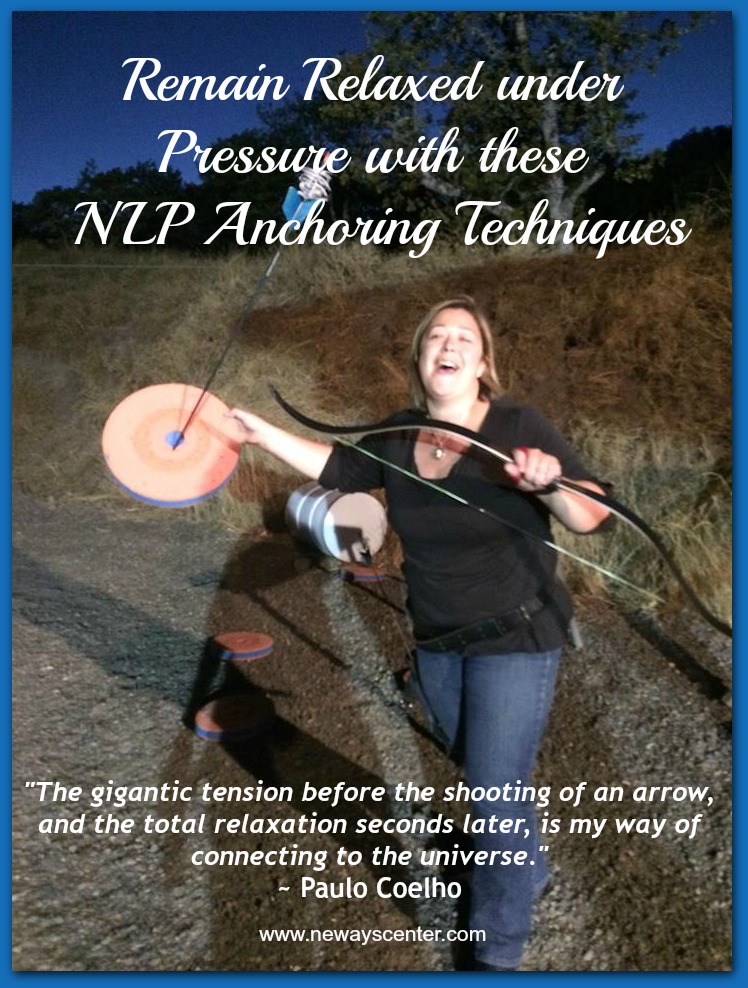
Remain Relaxed Even Under Pressure with these NLP Anchoring TechniquesStressed out. Strung out. Uptight. On edge. Tense. Nervous. People have such a hard time achieving a deeply relaxed state of mind. Any little thing can set them off, send them over the edge. This is taking a terrible toll on the emotional, mental, physical, and spiritual health of us and our loved ones.

Earlier, I shared a number of ways to achieve deep relaxation through Progressive Muscle Relaxation and simply making time for things you enjoy. (Yes, that’s me in the picture. I love archery!) As mentioned, to get the most benefit, focus on relaxation via the body, via the mind, and via the soul.

What do I mean by Deep Relaxation via the Soul?

A lot of people say that they can’t relax because their lives are chaotic and messy. It’s important to practice your ability to relax fully no matter the circumstances or the conditions around you. Neuro-Linguistic Programming (NLP) teaches us that we can choose any psychological state at will. This means that you can experience bliss, joy, gratitude, or love no matter what is happening in your life. And one of the NLP techniques that helps you do this is called “anchoring”.

In NLP, "anchoring" refers to the process of associating an internal response with some external or internal trigger so that the response may be quickly and subtly accessed.

NLP anchoring techniques are based on science. Russian scientist, Ivan Pavlov, famously demonstrated how conditioning works. He rang a bell every time dogs were fed. Soon the dogs psychologically associated the smell and taste of food with the sound of the bell. So even if the food was not present, the dogs would salivate at the sound. The bell (an external trigger) caused a real physiological response (salivation) even though the smell and taste were absent.

NLP anchoring techniques similarly cause you to psychologically associate a signal or trigger (tapping your chest, snapping a rubber band, squeezing your fingers) with a physiological response (an emotion, mood, or mental state) of your choice. When you experience a negative emotion, you can trigger a positive emotion and extinguish the negative one. This thereby allows you to choose your mood or state of mind no matter what the circumstances are.

Here are 7 Easy Steps to Anchoring a Resourceful State of Mind:

  • Decide on the state you want to anchor. For example being calm and relaxed.
  • Recall a memory or imagine a situation where you can experience the state. Make it very detailed and vivid, using all your senses.
  • When the experience is vivid and you’re in the desired state, connect it with a part of your body. For example, put your hand on your heart when the state is at its peak!
  • Now, break state by removing your hand and doing something else. Open your eyes, count down from 10 to break state and distract yourself.
  • Apply the anchor by just placing your hand on your heart and check that the required state, such as calmness or peace, occurs again.
  • You may need to repeat the anchoring process a number of times to make the experience sufficiently intense.
  • Use your new anchor in the situation where you want to experience the desired state. For example, when you’re feeling stressed during your next business meeting, place your hand on your heart and make sure it creates a sufficiently robust resourced state of calmness.

NLP anchoring techniques are really a method of deep relaxation that is best learned under the guidance of a trained professional. If you’d like to add this excellent tool to your life skills, please contact me and I’d be happy to help you finally achieve the peace you crave.
Achieve Deep Relaxation through Progressive Muscle Relaxation Techniques

Deep relaxation can be achieved no matter where you are or what you’re doing if you learn these Progressive Muscle Relaxation and NLP anchoring techniques.It feels so good to deeply relax! Do you find that these moments are all too rare for you? Does the idea of relaxing at a deeper level seem illusive?

While there are no specific guidelines for how much relaxation a person should incorporate into their lifestyle, making time to unwind and enjoy life is an important part of maintaining good health. 

To get the most benefit from your periods of relaxation, strive to achieve deep relaxation via the body, via the mind, and via the soul.

1. Deep Relaxation via the Body:

Deep relaxation, like meditation, exercise and deep breathing, when practiced regularly, is shown to have many potential benefits, such as, improved mood, decreased blood pressure, alleviated stress, anxiety and pain, and improved immune and cardiovascular systems.

You can achieve deep relaxation of the body by practicing Progressive Muscle Relaxation. Here’s how:

Create a relaxed, uninterrupted atmosphere by putting on loose clothing, playing soft music, dimming the lights, and shutting off the world around you.

Sit in a comfortable chair that supports your head and back. You can also do this exercise lying down if you’re trying to get to sleep.

Taking a few deep breaths, close your eyes and clear your mind. As you breathe in slowly, visualize what’s making you tense. As you slowly breathe out, visualize that you’re releasing those feelings. Imagine that all intruding thoughts are clouds sailing over you, so they move on and don’t fill your mind.

Progressively tense and relax every area of your body. As you proceed, think about how you would describe the relaxed state. If you can associate the relaxed state with a color, word, or image, you’ll attain deep relaxation more quickly in the future.

  • Make a fist with your right hand, tightening the muscles of your hand and forearm. Count 10 seconds. Then allow your hand to open and your arm to relax as you count 10 seconds. Do the same with your left hand and arm. Feel the difference between the relaxed state and the tense state. Repeat.
  • Make a fist with your right hand, and bring it up to your shoulder, tightening your upper arm. Hold for 10 seconds. Release. Repeat with your left arm. Allow tension to flow out through your fingertips. Repeat both arms.
  • Now focus on your head. Raise your eyebrows as high as you can, hold for 10 seconds. Relax. Allow your forehead to become smooth. Repeat. Next bring your eyebrows together, as you frown deeply. Hold for 10 seconds. Relax. Repeat. Next, purse your lips into an ooh (like a monkey sounds). Hold for 10 seconds. Fully relax until your mouth falls slightly open. Next, clench your jaw tightly. Hold 10 seconds. Release. Relax fully. Repeat. 
  • Raise your shoulders toward your ears, allowing your shoulder and neck muscles to tighten. Hold for 10 seconds. Allow your shoulders to drop. Feel the tension flow down and out fingertips. Relax for 10 seconds. Repeat. Next, press the back of your head against the chair, tightening the muscles in the back of your neck. Hold 10 seconds. Relax 10 seconds. Focus on the relaxed feeling and allow it to spread throughout your neck. Repeat.
  • Move your focus to your upper back, mid-back, and abdomen. Begin by pressing your shoulder blades together. Hold for 10 seconds. Release 10 seconds. Repeat. Take a couple of deep breaths in and out, releasing any remaining tension. Next arch your lower back just enough to tense the lower back muscles. Hold 10 seconds. Release 10 seconds. Repeat. Tuck your abdomen in tightly. Hold for 10 seconds. Release 10 seconds. Repeat. Breathe deeply a couple of times to release any remaining tension.
  • Finally, focus on your buttocks and legs. First, squeeze your buttocks together, hold for 10 seconds. Release for 10 seconds. You can choose to work on your legs separately or together. Bring your legs straight out in front of you and point your toes toward your face. Tighten your calves and thighs. Hold for 10 seconds. Release for 10 seconds. Repeat. Allow tension to flow down your legs and out the bottom of your feet.

Once you complete the Progressive Muscle Relaxation routine, scan your body for areas that still feel tense. Repeat the tensing and relaxing for that muscle group. Allow yourself to stay in the relaxed state for a few moments. Open your eyes. How do you feel?

Note: When tensing the muscles, don’t over tighten a muscle to the point of pain. If you have an injury, consult your doctor or therapist to determining the best method of tensing and relaxing that muscle group.

2. Deep Relaxation via the Mind:

Making time to find enjoyment is also an important element of relaxation. Get out of your mind often and distract yourself from your worries by making room for leisure and play. After all, laughter is good medicine! It decreases pain, helps your heart and lungs, promotes muscle relaxation and reduces anxiety.

We’ll discuss Deep Relaxation via the Soul in an upcoming blog post. Many people have found that they relax more fully if a coach guides them through the steps, rather than trying to do them from written instructions. If this is true for you, contact me and we can arrange a session that works for you.

Embrace the Power of Human Touch for Greater Health and Happiness

Embrace the Power of human touch for greater happiness and health“To touch can be to give life.” ~ Michelangelo

Can a hug a day keep the doctor away? There’s plenty of evidence that the power of human touch like a hug, a pat on the shoulders, or holding hands does improve your physical and mental health!

It’s no wonder that people in our society are lonely, depressed and anxious. They are touch deprived. Especially in the United States, people minimize the importance of closeness and touch for adults because we’re raised to be independent, resilient and individualistic. It’s amazing how many people claim they don’t have anyone to hug or to get hugs from. Sadly, most people have not experienced good touch or platonic touch that doesn’t lead to a sexual encounter. So they’re afraid to be the person who reaches out with a touch or hug.

The science behind the power of human touch

Neuroscientist Edmund Rolls discovered that touch activates the brain’s orbitofrontal cortex, which is linked to feelings of reward and compassion. Touch soothes cardiovascular stress. The skin contains encapsulated nerve endings called corpuscles and Merkel cells that register the pressure of each touch and sends a message to the brain, which then triggers a hormonal reaction. So a hug from a loved one reduces cortisol – the stress hormone, while releasing melatonin, serotonin and oxytocin – the feel good and love hormones.

To show how powerful human touch is studies show that a person can identify strong emotions like love, anger, gratitude, or fear just from a touch without even being able to see the other person!

Neuroscientist, psychologists, and researches have discovered fascinating things about the power of human touch. Here are some of their findings:

  • Those who are touched are much more likely to cooperate and share with their partner.
  • NBA basketball players who touch each other the most win the most games.
  • Touch from a loved one calms the stress activity in the brain so perceived threats aren’t as scary.
  • Preemie babies gain 47% more weight, have less pain and autoimmune disease symptoms after touch therapy than preemies who receive standard medical treatment. 
  • Touch helps Alzheimer’s patients to relax, make emotional connections, and reduce depression symptoms.
  • Massage therapy reduces pain and prenatal depression in pregnant women.
  • Eye contact and a pat on the back from the doctor boost survival rates of patients with complex diseases.
  • Students who receive friendly pats from the teacher are three times more likely to speak up in class.
  • When librarians pat the hand of a student checking out a book, the student likes the library more and is more likely to come back.
  • Autistic children, widely believed to hate being touched, respond well to being massaged by a parent or therapist.
  • Touch lowers glucose levels in children with diabetes.
  • Touch therapy improved immune systems in people with cancer.
  • Patients who get a massage regularly heal faster, feel more comfortable and get greater pain relief as they are able to relax more fully.
  • Cuddling your furry pet improves immune function, reduces blood pressure and eases the perception of pain.

As psychotherapist Virginia Satir famously said, "We need 4 hugs a day for survival. We need 8 hugs a day for maintenance. We need 12 hugs a day for growth." No matter what our age, we need to be touched, whether it’s a hug, a back rub, a pat on the back, a squeeze of the shoulder or even a hand shake. Touch is fundamental to everything we think and feel, how we communicate and bond, and whether or not we catch a cold.

A word of caution, however – let the reaction of others guide how much you touch them. If someone has been physically abused, touching them without permission may increase their stress.

Somatic coaching and therapy is an excellent way to create subtle shifts in how you use your body to influence, listen, be resilient, manage stress, maintain energy and be more effective. Rather than numbing yourself to uncomfortable circumstances and powering through them, contact me to learn how to respond in a way that leaves you feeling whole and at peace.

Touch is just one of the indicators of a life well lived. Take the 7-Point Body Wellness Assessment to see how you’re doing. Click here to download your free copy. And don’t forget that January 21, 2016 is National Hugging Day. How many people will you hug?

Five Breathing Exercises for Balancing Your Life, Your Mood and Your Relationships

Five Breathing Exercises for Balancing Your Life, Your Mood and Your RelationshipsDid you know that how you breathe reveals how you’re living your life? The ebb and flow of life consists of taking in and giving out or controlling and letting go. Isn’t that what breathing is like too?

How would you describe your quality of life? Smooth, balanced and rhythmic? Or is it a wild up and down rollercoaster ride? Perhaps you fall somewhere in between? Science has proven that there’s a definite link between tension or relaxation and the rate and depth of your breathing.

Do you carry an excessive amount of tension without even realizing it? Do you commonly have cold hands and feet even when you’re in a room-temperature environment? Do you have clammy hands because of an adrenaline release? Are you stiff in the morning and do you have excess wrinkles on your face because you’re always tense? Do you chronically feel tired? Have headaches, stomachaches and backaches? Do you always strive for perfection? Are you accident-prone? All of these are indicators that your body is too stressed.

Your body is not designed to always be uptight, to be out of balance. This excess tension will, in time, break down your health and spirit. Consciously using breathing techniques can break this pattern of stress. When you feel foggy and tired, use the following breathing exercises to clear your head, until you feel energetic yet calm.

Breathing Exercise 1

  • Stand up. Relax your knees.
  • Place your hands on your upper thighs.
  • Bend from the crease between your legs and torso.
  • Inhale deeply through your nose.
  • Exhale forcefully through your mouth while pulling your navel back toward your spine.
  • Push all the air out of your lungs.
  • Repeat.

Breathing Exercise 2

  • Stand up with your arms above your head.
  • Rhythmically jump up and down like you’re jumping rope.
  • As you jump up, inhale quickly.
  • As you land, expel your breath with a "huh."
  • Start with a half-minute session.
  • Gradually increase the duration for each session until you achieve five minutes.
  • Stop and return to breathing normally.

Breathing Exercise 3

  • Stand up.
  • Inhale through your mouth as you raise your arms above your head, stretching for the ceiling.
  • Go up on your tiptoes.
  • Reach even higher, inhaling all the way.
  • Release.
  • Go limp, bend from the waist and let your head and arms dangle at your side as you exhale vigorously.
  • Stop and return to normal breathing.

Breathing Exercise 4

  • Take three long deep breaths.
  • Keep your focus by saying, “breathe in slowly, deeply”.
  • Exhale thoroughly.
  • Keep your focus by saying, “Breathe out fully, smile, feel peace”.
  • Repeat.

Breathing Exercise 5

Do the yoga alternate nostril breathing exercise.

  • Exhale completely, using both nostrils.
  • Press your finger against your right nostril, closing it completely.
  • Inhale slowly and smoothly through the left nostril only.
  • Hold that inhaled breath for a few comfortable seconds.
  • Then close the left nostril and exhale through the right nostril.
  • Hold while comfortable.
  • Inhale through the right nostril only.
  • Release your left nostril and close off the right.
  • Exhale through the left nostril. Hold.
  • Keep switching between left and right nostrils as you inhale and exhale rhythmically for a total of 10 to 15 sets.
  • Go back to breathing through both nostrils.


Do you feel like you’ve created a new awareness by increasing your ability to breathe mindfully? I’d love it if you’d come to my Facebook Page and tell us your wins so we can encourage each other to keep going.

As a heads up, there are still other wellness indicators that we’ll discuss in the future. But why wait? Take the 7-Point Body Wellness Assessment today and get a jumpstart on making the coming New Year the best one yet. Click here to download your free copy.

You Can Be Merry and Be Healthy – It’s Okay to Take Care of Yourself!

it's okay to take care of yourselfDon’t you love the holiday season with its bright lights, lovely music, and pleasant aromas of pine trees and baked goodies? It’s such a festive time of the year!

Yet all that glistens is not gold, as the saying goes. There are inevitable stresses during this time of year. Rather than writing a typical “how to relieve your holiday stress” article, I’m sharing something you really need to hear…

But first…Which of the follow stress triggers really get you down the most? (Please come over to my Facebook Page and let’s share.)

  • Is it feeling trapped by obligations, being pushed beyond what you can physically and emotionally handle?
  • Is it spending beyond your budget, thinking you’ll deal with it later, when in reality the bills nag at you, robbing you of joy?
  • Is it falling into unhealthy patterns due to your history, family traditions and personal beliefs?
  • Is it being thrown together with a family member who brings you pain?
  • Is it seeing an empty place where a loved one was last year, but isn’t this year?
  • Is it the disruption to your routine that allows little down time that makes you crazy?
  • Is it feeling guilty for eating and drinking things you normally wouldn’t?

Your ability to handle all of these stress triggers revolves around one thing…your self-care. And I’m sure you’ve already read plenty of articles of how to deal with holiday stress that tell you to do this and do that. What you really need is permission to take care of yourself – to be told it’s not selfish to nurture your own wellbeing. So let me reassure you…

It’s okay to set limits to what you can do physically and emotionally.

It’s okay to set a budget for what you can spend and then stick to it.

It’s okay to do things differently than everyone else.

It’s okay to start a new family tradition.

It’s okay to schedule alone time to think about how you can make even a slight change in the coming year.

It’s okay to be more deliberate about your choices.

It’s okay to indulge a little.

It’s okay to treat yourself to a massage or a brief getaway to gain some breathing room.

It’s okay to walk away from family squabbles and go for a walk or to the gym.

It’s okay to insist on getting to bed at a reasonable hour.

It’s okay to bring new meaning into your holiday: identifying why and what are you celebrating… family, connection, or spiritual growth.

It’s okay to take time out to do breathing exercises to center and balance yourself when you feel tense.

It’s okay to view friends as family, if your family has let you down.

It’s okay to say, “No! Not this year”.

Didn’t you feel the stress flow away as you read, “it’s okay”? We all need reassurance that we can choose what’s okay for us.  In the same manner, we respectfully and lovingly allow others to have the same freedom of choice. As each person calmly explains their point of view, it can promote peace and greater awareness – the very foundation of being merry and being healthy. And that’s what I wish for you. Have a happy holiday season everyone! See you on my Facebook Page.


Let's get started with 30 free minutes

I invite you to learn more about me and my coaching and counseling services. Please contact me to schedule an “It starts with you!” 30-minute complimentary consultation with me, in-person, by phone or via video consultation, so we can explore our partnership.

SCHEDULE


How to Step Forward to a Future You've Created

Discover how to replace your old, self-limiting map with a new map full of possibilities for the future

DOWNLOAD YOUR FREE INTRO TO STEPPING FORWARD TODAY!